


Painting sets of two or three panels are known as diptychs and triptychs. They are modern design solutions used to fill large wall spaces with cohesive imagery without the physical weight and logistical difficulty of a single massive canvas. These sets work best when you need to anchor a large piece of furniture, such as a sofa or bed, or when you want to create a sense of movement and narrative across an expansive room. By splitting a composition into multiple panels, you allow the negative space between them to become part of the art itself, creating a sophisticated visual rhythm that single-panel works often lack.
Understanding Diptychs and Triptychs in Modern Wall Art
To effectively use modern wall art in your home, it is essential to understand the basic terminology that curators and designers use. Multi-panel art is categorized by the number of individual canvases or boards that make up the complete piece. For placement above major furniture, see how to choose a painting set above a sofa or bed.
What is a Diptych?
A diptych consists of two panels that are intended to be displayed together. Historically used for portable altarpieces, the modern diptych is a staple in contemporary interior design. These sets can feature one continuous image split down the middle or two distinct but related images—such as a pair of "blue and green abstract" pieces—that share a common horizon line, color palette, or stylistic execution.
What is a Triptych?
A triptych is a set of three panels. This format is particularly popular for large abstract wall art because it provides a clear beginning, middle, and end. The symmetry of a triptych naturally draws the eye to the center panel, making it a powerful tool for creating a focal point in a dining room or over a king-sized headboard.
Both formats rely on a cohesive color palette to ensure the panels feel like a singular statement. Whether you are looking at a panoramic landscape or a minimalist texture piece, the goal is to provide visual continuity across the gaps. This allows the eye to travel fluidly from one panel to the next, bridging the physical distance between the canvases.
Diptych vs Triptych for Your Room Scale

Choosing between a set of two or three depends heavily on the dimensions of your wall and the scale of the furniture in the room. While both styles add significant impact, they interact with spatial volume differently. If you are comparing panels with one large canvas, read oversized wall art vs sets of 2 or 3.
| Feature | Diptych (Set of 2) | Triptych (Set of 3) |
|---|---|---|
| Ideal Wall Width | Narrower to medium walls | Large, expansive walls |
| Visual Weight | Balanced and stable | Rhythmic and dynamic |
| Flexibility | Easier to fit in awkward spaces | Requires significant horizontal clearance |
| Common Ratio | Often vertical or square | Frequently horizontal/panoramic |
| Narrative Flow | Comparison or contrast | Sequential storytelling |
A diptych is often the superior choice for vertical orientations or narrower wall sections between windows. If you have a tall, slim wall in an entryway, two stacked vertical panels can create height. Conversely, a triptych excels in open-plan homes where the wall surface is vast. The triple-panel layout breaks up the monotony of a long wall better than a single canvas, providing a "staccato" rhythm that keeps the viewer engaged.
The 2/3 Rule for Anchoring Art to Furniture
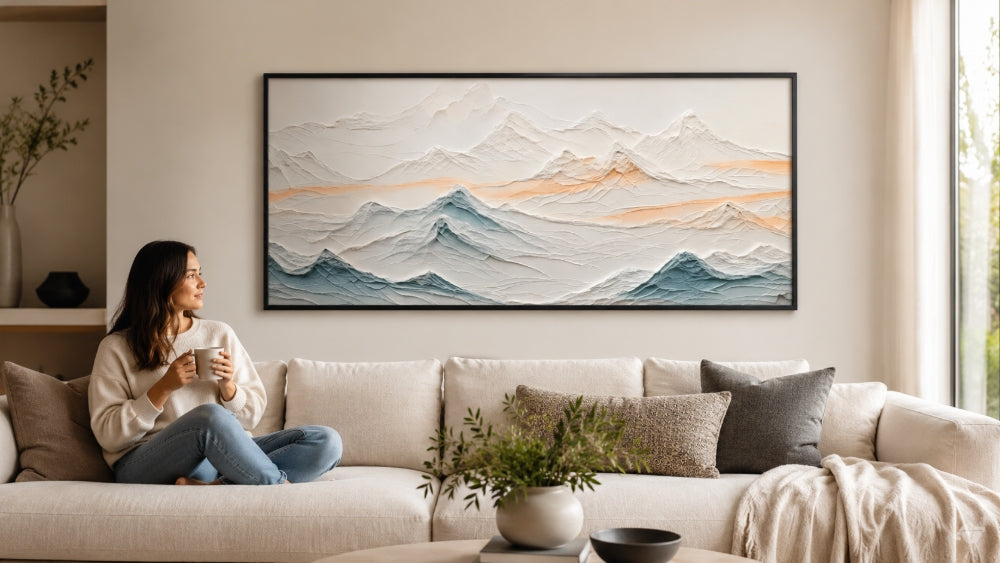
The most common mistake in home decor is hanging art that is too small for the furniture beneath it. Professional designers use the "2/3 Rule" to ensure that canvas wall art looks intentional and grounded. This rule states that the total width of your art set should occupy approximately two-thirds to three-quarters of the width of the furniture it is hanging above.
How to Calculate the 2/3 Rule
- Measure the Furniture: Measure the total width of your sofa, bed, or console table.
- Multiply by 0.66: This gives you the minimum width your art set should cover.
- Include the Gaps: When calculating the width of a set of 2 or 3, remember to include the 2 to 3 inches of space between each panel.
- Check the Height: Ensure the art is hung 6 to 10 inches above the top of the furniture to maintain a visual connection.
Ideal Scenarios for Multi-Panel Art Arrangements
Multi-panel sets are not just about filling space; they are about enhancing the specific layout of a home. Here are three scenarios where sets of 2 or 3 work best: For especially wide walls, compare single canvas vs multi-panel art.
Panoramic Landscapes in Open Living Areas
When dealing with large landscape artwork, a triptych allows for a wide-angle view that a single canvas cannot easily replicate without becoming structurally unstable or difficult to transport. A panoramic mountain range or seascape split across three panels brings the outdoors in, creating a "window" effect that adds depth to a room.
Narrative Storytelling with Abstract Art
Abstract sets of 3 are perfect for telling a visual story. You might see a splash of color that begins on the left panel, peaks in the middle, and fades on the right. This progression guides the eye and can be used to connect different areas of a room, such as linking a dining area to a sitting area in an open-concept floor plan.
Professional Guidelines for Spacing and Alignment

The way you hang your set is just as important as the art itself. Improper spacing can make even the most expensive landscape paintings for sale look cluttered or disjointed. For a step-by-step installation process, use the multi-panel painting hanging guide.
The Standard Spacing Rule
For most medium to large canvas sets, a gap of 2 to 3 inches between panels is the industry standard. This distance is wide enough to let the negative space breathe but narrow enough for the eye to maintain a sense of continuity. If the gaps are too wide, the image will look broken; if they are too narrow, the panels may look cramped or accidentally misaligned.
Structural and Handling Safety
When installing large sets, hardware choice is critical. Falling damage is often the result of aged hardware or unsuitable wall attachments. For heavy canvases, ensure you are using wall anchors rated for the specific weight of each panel. Additionally, large panels or canvases should be carried by two or more people to prevent twisting the frame or damaging the corners during the hanging process. Applying a backing board to the rear of the canvas can also protect the work from dust and humidity fluctuations once it is on the wall.
Design Benefits of Splitting Art over Multiple Canvases
Beyond aesthetics, there are practical and structural advantages to choosing a set of 2 or 3 over a single massive piece of art. First, there is the issue of visual rhythm. A single large canvas is a heavy, singular block of color. A triptych, by contrast, introduces vertical lines of negative space that break up the wall surface.
Second, the logistics of installation are significantly improved. A 72-inch wide single canvas is a nightmare to ship, carry up stairs, and hang safely. Three 24-inch canvases provide the same 72-inch footprint but are much easier to handle. This also means the physical weight is distributed across multiple hanging points, reducing the stress on your drywall.
Choosing the Best Painting Sets of 2 or 3 for Your Home
In conclusion, understanding what painting sets of 2 or 3 are and when they work best allows you to curate your home like a professional. Whether you choose a balanced diptych for a cozy bedroom or a sweeping triptych to dominate a modern living room, the key is to respect the scale of your furniture and the architecture of your walls. By following the 2/3 rule, maintaining consistent 2-to-3-inch spacing, and selecting a cohesive color palette, you can transform a plain wall into a sophisticated focal point. Multi-panel art is more than just a decor trend; it is a practical and powerful tool for bringing balance, narrative, and rhythm to your interior design.
Safety Notice
This article provides general guidance only. Always follow the manufacturer's instructions for hanging hardware, consider the structural load limits of your wall type, and use appropriate safety equipment. For installations involving heavy artworks, high-reach areas, or complex wall materials, consult a qualified professional to ensure the art is secured safely and permanently.
FAQs
How much space should be between two paintings in a set?
For medium to large canvas sets, you should leave a gap of 2 to 3 inches between each panel to maintain visual continuity while allowing the negative space to act as a design element.
Can I hang a triptych on a small wall?
A triptych may look crowded on a small wall. In restricted spaces, consider a vertical diptych (set of 2) or a single smaller canvas to avoid overwhelming the room's proportions.
Should multi-panel art be framed or canvas-wrapped?
Gallery-wrapped canvases are most common for multi-panel sets because the image can continue around the edges for a seamless look. However, thin 'floater' frames can also be used to define the individual panels without interrupting the narrative.


Leave a comment
This site is protected by hCaptcha and the hCaptcha Privacy Policy and Terms of Service apply.