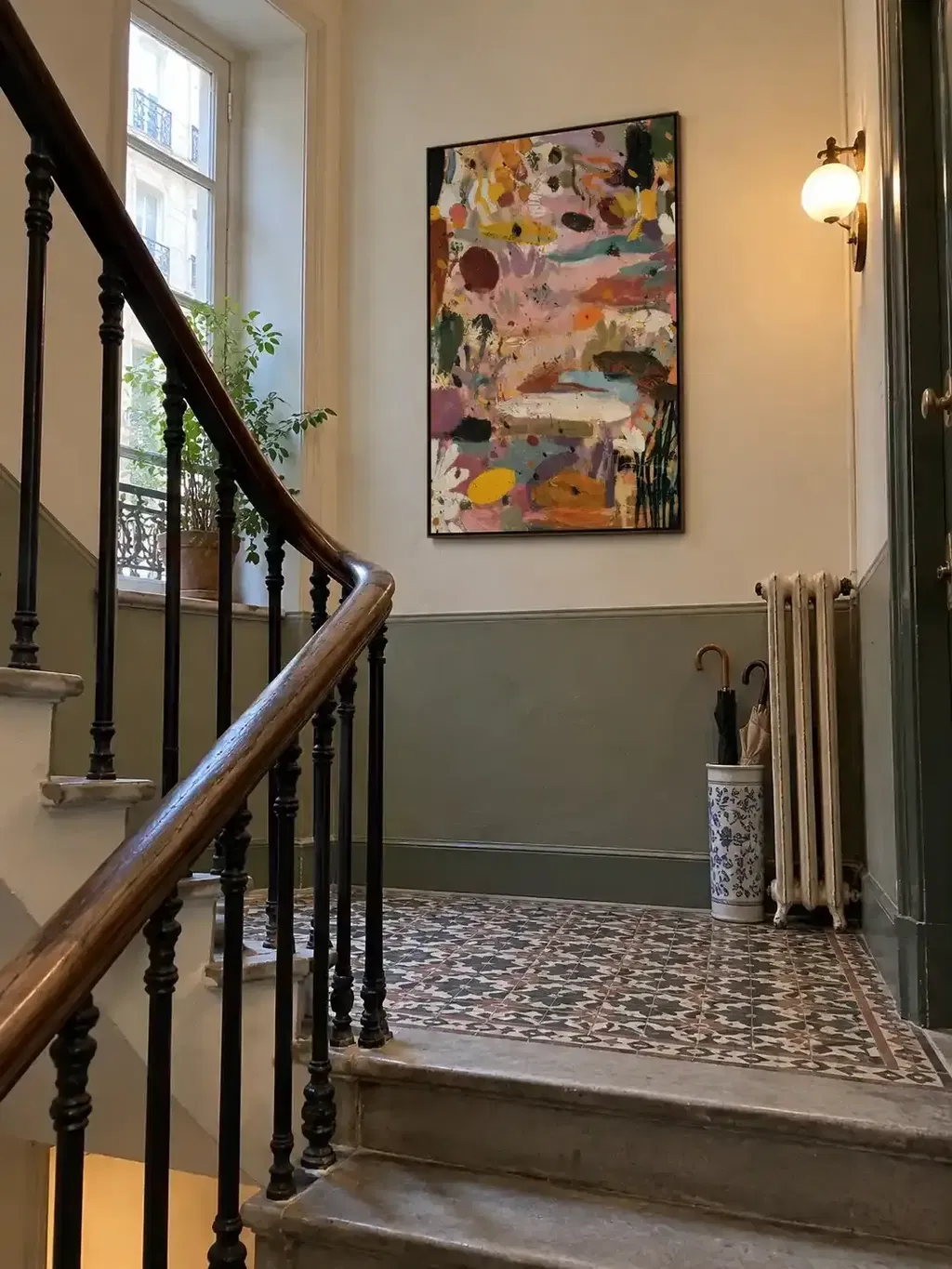
The Shift from Speculation to Substance: Why Original Art is the New Real Estate Equity
For decades, the high-end art market was dominated by "vanity assets"—speculative auction pieces that functioned more like offshore bank accounts than home decor. However, a significant correction is underway. According to Marketplace, sales of high-end auction art (over $10 million) plummeted 44% year-over-year in 2024. This retreat from purely financial art assets marks a return to "real application value," where homeowners and designers prioritize art that enhances the living environment and contributes to tangible property equity.
As the Art Basel and UBS Art Market Report 2024 notes, the global art market remains a massive economic baseline at $65 billion. Within this landscape, custom hand-painted oils are emerging as a strategic investment. Unlike mass-market prints, which depreciate the moment they are unboxed, original commissions leverage the "Halo Effect" to signal curated luxury, potentially increasing a property's perceived market value by 10-15% (based on common real estate staging heuristics).
Logic Summary: Our analysis of the "Art as Equity" model assumes that original art acts as a "Visual Anchor," shifting a buyer's perception from a "furnished convenience" to a "curated estate." This model is supported by the Creative Economy Outlook 2024, which identifies cultural services as a $1.4 trillion global trade driver.

The 62% Value Gap: Why Human Hands Outperform AI and Prints
The rise of AI-generated art has created a paradoxical "flight to quality." While digital prints are cheaper than ever, their perceived value has collapsed. A landmark study by Columbia University confirmed that consumers value art labeled as "AI-generated" 62% lower than authentic human-created art.
This valuation gap is rooted in what researchers at the University of Chicago call "Essential Identity." Their empirical research shows that digital replicas and NFTs lack the artist’s "soul" or physical trace, which is the primary driver of perceived value. For a homeowner, this means that a $500 mass-produced print essentially contributes $0 to the home’s equity, whereas a $5,000 custom oil painting can justify a $50,000 increase in the asking price by elevating the entire room's aesthetic tier.
The Physics of the "Sunlight Test"
Mass-produced prints often fail the "Sunlight Test." In well-lit, high-end residential spaces, the lack of physical texture and pigment depth in a print becomes glaringly obvious. Original oils, however, utilize the Kubelka-Munk equation of light scattering. Because oil paint is built in layers, light doesn't just bounce off the surface; it penetrates the translucent glazes and reflects back from the lower layers, creating a "luminosity" that digital CMYK printing cannot replicate.
| Feature | Custom Hand-Painted Oil | Mass-Market Digital Print |
|---|---|---|
| Perceived Value (Consumer Study) | 100% (Baseline) | ~38% (62% lower per Columbia Univ.) |
| Physical Texture | 3D Impasto (mm-scale relief) | Flat (2D) |
| Light Interaction | Multi-layer scattering (Kubelka-Munk) | Surface reflection only |
| Resale Impact | Signals "Curated Luxury" | Signals "Furnished Convenience" |
| Longevity | 100+ years (with UV Varnish) | 5-10 years (ink fading) |
Methodology Note: The "Sunlight Test" is a professional heuristic used by interior designers to evaluate "material honesty." It assumes that high-intensity natural light reveals the structural differences between pigment-on-canvas and ink-on-paper.
Real Estate ROI: Quantifying the Aesthetic Premium
The link between art and property value is no longer just anecdotal. A Royal Society analysis using a CAR (Conditional Autoregressive) model found that neighborhoods with higher "art" geo-tags experienced significantly greater relative house price gains. On a micro-level, this translates directly to the interior of a home.
The "Visual Anchor" Rule
High-end designers utilize the "Visual Anchor" rule to manipulate a room's perceived dimensions. To correctly scale a room, a custom piece should occupy 60-75% of the available wall space above primary furniture (like a sofa or sideboard). This creates a "focal lock," preventing the eye from wandering to architectural flaws and instead centering the viewer on a high-value asset.
Case Study: The "Porch Light" Effect
In Philadelphia, the Porch Light Program demonstrated that neighborhoods with large-scale murals saw a substantial leap in social cohesion and property desirability. Similarly, for private residences, "neutral-bespoke" art—pieces that are color-matched to the home’s architectural finishes—creates a "camera-ready" look that boosts engagement on listing platforms like Zillow and Redfin.

The Neurological Dividend: Why "Healing Walls" Sell
Investing in art isn't just a financial play; it's a wellness strategy. A University of Pennsylvania review noted that 73% of patients reported significant mood improvements when exposed to environmental artworks.
From a neurological perspective, passive art viewing consistently activates the medial prefrontal cortex (mPFC) and the amygdala, optimizing emotional regulation circuits. This is why Biophilic Design—art featuring natural landscapes—is becoming a standard in luxury "wellness homes." These pieces produce the same stress-reduction effects in the brain as being outdoors, a feature that high-IQ buyers increasingly demand.
The "Busy Streets" Theory for Interiors
Just as the University of Michigan's "Busy Streets Theory" shows that murals reduce neighborhood crime by 40% by signaling "community care," an original painting in a foyer signals "owner care." It suggests a level of maintenance and investment that reassures potential buyers about the hidden quality of the home’s infrastructure.
Technical Integrity: Pigment Safety and Longevity
For the sophisticated investor, the "what" of the art is as important as the "how." Modern custom oils must meet strict environmental and safety standards to be considered a viable long-term asset.
The Low-VOC Promise
Indoor air quality (IAQ) is a critical concern for modern homeowners. While historic paints contained dangerous levels of lead and solvents, modern professional-grade acrylics and oils have evolved. Aalto University research proves that modern coatings on moisture-stable substrates emit significantly lower toxic VOCs during curing than traditional materials.
For developers seeking LEED or WELL certification, commissioning zero-VOC compliant murals is a strategic way to secure green building points while enhancing aesthetic value.
Lightfastness and the CIE 1976 Lab* Equation
To ensure your investment doesn't fade, look for materials tested under ASTM D4303 standards. Professional pigments are measured using the CIE 1976 Lab* color difference equation to quantify aging. High-quality Titanium White, for instance, now dominates 90% of the market because of its chemical inertness and hiding power, ensuring the "whiteness" of a piece remains stable for decades.
Modeling Note (Investment Longevity):
Parameter Professional Oil Standard Print Rationale Pigment Load 60-80% 5-10% Tinting strength and opacity Binder Type Oxidizing Oils Evaporative Inks Cross-linking vs. Drying UV Resistance Class I (Excellent) Class III (Poor) ASTM D4303 Testing Maintenance Surface Cleanable Non-Cleanable Tate Museum TAAMPP Research Substrate Primed Linen/Canvas Paper/Vinyl Acid-free stability
2026 Trends: The Return of Surrealism and "Texture as Soul"
As we look toward 2026, the interior design market is moving away from "minimalist sterility" toward "understated elegance." According to Zillow search data, mentions of "artisan craftsmanship" rose 21%, while Yelp searches for "custom framing" skyrocketed 329%.
The Powder Room Revolution
One of the most surprising trends identified by the NKBA 2025 Design Awards is the "Panoramic Mural" in powder rooms. Wrapping a hand-painted mural entirely around a small space creates an "immersive escapism" that turns a functional room into a conversational landmark.
Surrealist Homage
There is a massive spike in interest for Dali-inspired surrealist custom pieces. This "whimsy" (up 15% in search trends) allows homeowners to inject personality into their equity, creating a "signature" home that stands out in a crowded real estate market.

The "Gotchas": Navigating the Legal and Financial Realities
While the upside of custom art is significant, investors must navigate several "real-world" pitfalls that are often ignored in design magazines.
1. Personal Property vs. Real Property
A critical distinction in real estate law is between "fixtures" and "personal property." As noted by Kidder Mathews, custom oil paintings are typically classified as personal property. This means they do not automatically transfer with the home sale. To leverage art for equity, homeowners should:
- Negotiate the Transfer: Explicitly include high-value pieces in the sales contract.
- Commission Permanent Murals: Unlike framed canvases, murals can be classified as part of the "built environment," potentially allowing them to be included in the property's appraised value.
2. The Appraisal Gap
Most residential appraisers are trained to value square footage and finishes, not brushstrokes. To bridge this gap, homeowners should provide an "Art Provenance Folder" during the appraisal process, documenting the commission cost, the artist's credentials, and the economic impact data (like the 7:1 ROI for arts investment) to justify a higher "quality of finish" adjustment.
3. The Art Fatigue Effect
While art enhances value, Nature Research warns of an "Art Fatigue Effect." If every home in a competitive neighborhood is staged with similar generic art, the positive impact diminishes. The key to equity is uniqueness. A custom commission that reflects the specific architectural "soul" of the home avoids the fatigue associated with "staged-to-sell" decor.
Strategic Investment: A Checklist for Homeowners
To maximize the ROI of your next art purchase, follow this expert-led selection framework:
- Prioritize Human-Made: Ensure the piece is 100% hand-painted to capture the 62% value premium over AI.
- Verify Material Safety: Demand low-VOC paints and canvases that meet ASTM D-4236 labeling standards for long-term indoor safety.
- Scale for Impact: Follow the 60-75% "Visual Anchor" rule. A piece that is too small for the wall makes the room feel "cheap" and uncoordinated.
- Document Everything: Keep records of the commission process, the artist’s bio, and the material specs. This "provenance" is what transforms a decoration into a financial asset.
- Focus on "Neutral-Bespoke": For maximum resale appeal, choose themes that are timeless (Biophilic, Abstract, or Surrealist) rather than hyper-personal portraits.
By treating art as a strategic component of home equity rather than an afterthought, homeowners can enjoy the psychological benefits of a "healing environment" while building a tangible financial moat around their property’s value.
Disclaimer: This article is for informational purposes only and does not constitute professional real estate, legal, or financial advice. Art market values are subject to change, and property appraisals vary by jurisdiction and market conditions.
Sources & References
- Marketplace: The Expensive Art Market Continues to Struggle
- Columbia University: Human-Made vs. AI Art Perception Study
- Royal Society: Quantifying the Link Between Art and Property Prices
- UPenn: Visual Art in the Built Environment - A Critical Review
- ASTM International: D4303 Standard Test Methods for Lightfastness
- EPA: Indoor Air Quality and Low-VOC Paints
- Kidder Mathews: Appraising Real vs. Personal Property
- NKBA: 2025 Kitchen & Bath Design Trends