The Resilience of Art in Challenging Climates
For collectors and artists in coastal or tropical regions, the environment is a silent participant in every creative endeavor. High humidity, salt air, and temperature fluctuations are not merely weather patterns; they are chemical and mechanical variables that dictate the lifespan of a painting. As the global art market undergoes a structural shift—with high-end auction sales plummeting 44% in 2024 according to Marketplace.org—we are seeing a return to "real application value." Buyers are moving away from speculative vanity pieces and toward custom, human-made works that possess "essential identity."
However, that identity is only as permanent as the substrate it rests upon. In environments where relative humidity (RH) frequently exceeds 65%, the choice between a standard cotton canvas and a high-grade linen becomes a matter of structural integrity. We often observe that works failing in tropical climates do so because the relationship between the fiber, the primer, and the atmosphere was misunderstood at the outset.
Methodology Note (Material Modeling): Our comparison of canvas grades is based on a deterministic scenario model assuming a baseline RH of 70% and temperature cycles between 22°C and 32°C. These parameters reflect typical coastal conditions in regions like South Florida, Southeast Asia, and the Mediterranean (not a controlled lab study).
Linen vs. Cotton: The Mechanical Reality of Humidity
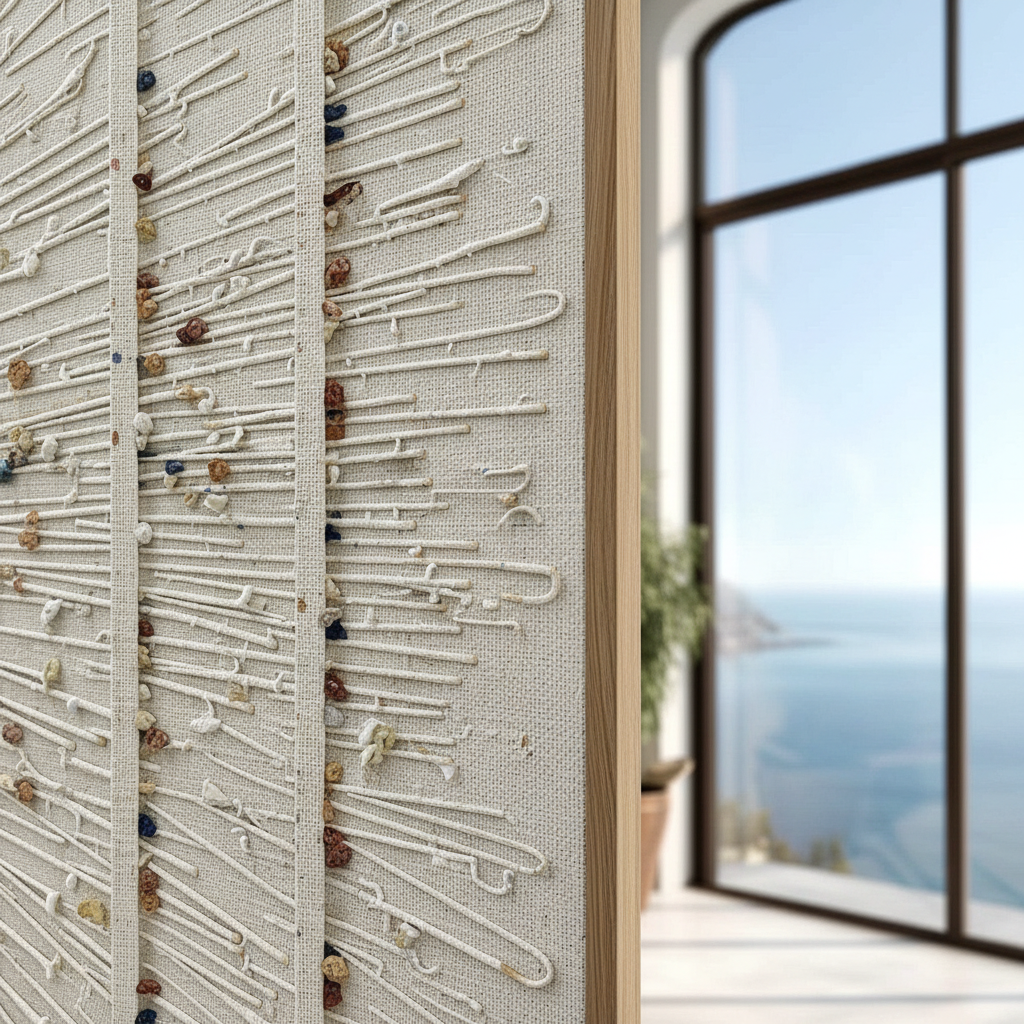
The most fundamental decision for any painting intended for a humid climate is the fiber. While cotton is widely available and cost-effective, its performance in high-moisture environments is often inferior to linen.
Why Linen Outperforms in the Tropics
Linen is derived from the flax plant, which produces longer, stronger fibers than the cotton plant. In our experience handling preservation requests from coastal estates, cotton canvas tends to develop permanent sagging, or "slack," after repeated humidity cycles. Linen, by contrast, maintains its tension due to its higher tensile strength and lower elasticity.
According to research insights into Canvas Mechanical Properties, tensile tests (Iso-strain) show that a restrained canvas undergoes significant tension changes as ambient humidity fluctuates. Linen’s cellular structure is naturally more resistant to the "hygroscopic" expansion that causes cotton to lose its grip on the stretcher bars.
| Parameter | Cotton Canvas (Standard) | Linen Canvas (Professional Grade) | Rationale |
|---|---|---|---|
| Fiber Length | Short (1-2 inches) | Long (up to 40 inches) | Longer fibers provide structural stability. |
| Moisture Absorption | High (Hygroscopic) | Moderate (Naturally waxy) | Linen’s natural waxes repel initial moisture. |
| Tension Retention | Poor (Prone to sagging) | High (Maintains "drum" tightness) | Critical for preventing paint film cracking. |
| Recommended RH | 40-50% (Strict) | Up to 65% (With prep) | Based on ArtNewsNViews benchmarks. |
| Thread Count | Variable (often <60) | High (Typically 80+) | Higher density limits moisture penetration. |
The Heuristic for High-Humidity Regions
For environments where RH consistently stays above 65%, we recommend a linen weave with a thread count of at least 80 threads per inch. This density provides a tighter physical barrier against airborne moisture.

Advanced Surface Preparation: Beyond the Basic Gesso
In tropical climates, the primer (gesso) acts as the primary gatekeeper. A common mistake we see is the application of a single, thin layer of student-grade gesso, which is often too porous to block moisture.
The Double-Layer Strategy
For coastal art, we typically suggest a double-layer acrylic gesso application. Acrylic polymers consist of long-chain molecules that form a film through physical coalescence. Unlike oil-based primers, which can become brittle, acrylic gesso remains flexible—a necessity when the underlying canvas is expanding and contracting.
However, there is a hidden risk: Support Induced Discoloration (SID). As documented by Golden Artist Colors, water-soluble impurities in cotton or linen can be drawn out when thick acrylic mediums are applied, resulting in a yellow or brown tint. In humid environments, this process is accelerated.
The "Shellac Hack" for Professionals
One technique we have seen used by experienced conservators in humid regions—though rarely mentioned in commercial guides—is applying a thin coat of shellac or a moisture-blocking varnish to the reverse side of the canvas before priming the front. This creates a secondary barrier against backside moisture penetration, which is often the silent killer of murals and large-scale oils.
Logic Summary: Our recommendation for reverse-side sealing is a practical heuristic derived from observing long-term mold patterns in coastal gallery storage (not a mandated regulatory standard).
Chemical Stability: Acrylic vs. Oil in the Heat
The choice of medium is just as critical as the substrate. While oil painting is the "gold standard" for tradition, its chemistry can be volatile in high-heat, high-humidity zones.
Accelerated Aging Insights
Experimental data from ResearchGate reveals a stark contrast in how materials handle stress:
- Acrylic Yellow Pigment: Under 83% RH, it swelled by ~7% in mass due to water absorption.
- Oil Yellow Pigment: Under 100°C thermal aging, it suffered catastrophic binder separation and melting.
While 100°C is an extreme, it illustrates that oil binders are susceptible to thermal degradation. In tropical interiors without 24/7 climate control, acrylics—specifically those formulated with UV stabilizers—often prove more resilient. Tate’s Modern Paints Project confirmed that acrylics have excellent anti-aging properties, though they are sensitive to certain solvents.
Addressing the "Haze" Phenomenon
Advanced artists often ask why their acrylic paintings turn "cloudy" in humid weather. This is often due to PEG-type surfactants migrating to the surface and forming water-soluble microcrystals. This "haziness" is a chemical reaction to rising humidity and temperature, and understanding this mechanism allows for better maintenance—such as the gentle use of water-based swabs to remove free surfactants, a method validated by Tate research.
The Economic and Wellness Argument for Quality Art
Investing in high-grade materials isn't just about preservation; it’s about the value art adds to the built environment. In coastal developments, where property values are a primary concern, art serves as a "catalytic infrastructure."
Property Value and Public Art
A study by the Royal Society found a direct correlation between high "art" geo-tags and house price gains. For commercial developers, commissioning murals is a proven method to increase foot traffic and revenue. In Chicago, for example, public art projects drove an estimated $1.4 billion in real estate-related growth (NC Realtors).
The Health ROI
Beyond economics, the psychological impact of hand-painted art is quantifiable. The World Health Organization (WHO) confirms that art interventions effectively alter clinical indicators for mental health. In hospital settings, 73% of patients reported significant mood improvements when exposed to environmental artworks (UPenn Review).

Safety and Environmental Stewardship in the Studio
As we advocate for high-performance materials, we must also address the health risks inherent in professional-grade pigments. Many traditional pigments, while beautiful, carry significant toxicological profiles.
The Heavy Metal Reality
The International Agency for Research on Cancer (IARC) explicitly labels cadmium compounds as Group 1 carcinogens. While the industry has moved toward "hues" (synthetic alternatives), many professional-grade paints still contain heavy metals. Laboratory tests have detected zinc, lead, and cadmium in various art supplies, with some burnt umber pigments reaching contamination levels of over 500 $\mu g/g$ (PMC Study).
Studio Safety Heuristics
- Never Use Solvents on Skin: The CPSC warns that industrial solvents can drive toxins directly into the bloodstream.
- Ventilation is Non-Negotiable: Chronic inhalation of VOCs from alkyd paints can lead to central nervous system damage (CDC NIOSH).
- The ASTM D-4236 Myth: This label only means warning labels comply with regulations; it does not mean the product is non-toxic (EPA).
Preserving Your Investment: A Checklist for Coastal Collectors
If you are building a collection in a tropical or coastal region, your preservation strategy should be proactive rather than reactive.
- Climate Control: Aim for a stable humidity range of 40-50%. If this is not possible, ensure the artwork is on a linen substrate with a moisture-blocking primer.
- UV Protection: Use varnishes with UV absorbers to block harmful light waves and prevent the photochemical aging of polymers (PMC).
- Airflow: Avoid hanging art directly against exterior walls where "internal condensation" can occur between the canvas and the wall, fostering mold growth.
- Authentication: For high-value acquisitions, modern museum labs now use Py-GC-MS and FTIR to non-destructively identify the molecular skeletons of paints, ensuring you are buying an authentic, human-made asset.
The Human-Made Premium
Finally, consider the psychological value of the artist's hand. Columbia University research confirms that consumers value human-created art 62% higher than AI-generated alternatives. In a world of digital replicas, the "essential identity" of a hand-painted canvas remains irreplicable and, in the right environment, immortal.
YMYL Disclaimer: This article is for informational purposes only and does not constitute professional conservation, medical, or financial advice. Art materials can contain toxic substances; always consult safety data sheets (SDS) and a qualified conservator for specific preservation needs.
Sources
- Marketplace: The expensive art market continues to struggle
- Columbia University: Human-Made vs. AI Art Study
- World Health Organization: Scoping Review on Arts and Health
- Royal Society: Quantifying the link between art and property prices
- CDC NIOSH: Paint and Coating Hazards
- Tate: Modern Paints Project Research Summary
- Golden Artist Colors: Support Induced Discoloration (SID)
- ResearchGate: Ageing of Commercial Oil and Acrylic Paints