Therapeutic Palettes: The New Era of Wellness-First Art
The high-end art market is currently navigating a profound structural shift. In 2024, auction sales for pieces exceeding $10 million plummeted by 44% year-over-year, according to Marketplace. This retreat from purely financial "vanity assets" signals a return to real application value. For homeowners and designers, art is no longer just a trophy; it is increasingly viewed as a functional component of the "built environment" intended to support mental and physical health.
In residential spas and recovery rooms, the choice of art medium and palette is a clinical decision as much as an aesthetic one. While the global art market remains a massive $65 billion industry (The Art Basel and UBS Art Market Report 2024), the demand is pivoting toward custom, hand-painted works that offer "essential identity"—a soul that digital prints and AI-generated imagery simply cannot replicate. Research from Columbia University confirms that consumers value art labeled "AI-generated" 62% lower than authentic human creations. In a wellness space, where the goal is authenticity and restoration, this "human premium" is irreplaceable.

The Neuro-Aesthetics of Healing Spaces
Why do hand-painted walls feel fundamentally different from a high-definition wallpaper? The answer lies in our neurobiology. A systematic review of neurological mechanisms published in NCBI shows that passive art viewing consistently activates the medial prefrontal cortex (mPFC) and the amygdala. These areas are critical for emotional regulation and stress reduction.
In healthcare environments, the impact is even more pronounced. A University of Pennsylvania review noted that 61% of patients at the Cleveland Clinic explicitly stated that environmental artworks reduced their stress, while 73% reported significant mood improvements. When we translate this to a residential spa, the art becomes a non-pharmacological intervention.
Biophilic Design and Cognitive Fatigue
The most effective palettes for these spaces often draw from biophilic design—the practice of connecting occupants to nature. Nature-themed art produces stress-reduction effects in the brain similar to being outdoors, which is essential for recovery rooms. For those designing high-density home offices or urban spas, this is a strategic tool. Research on Tokyo office spaces suggests that nature-based design effectively intervenes in high rates of cognitive fatigue and burnout.
Logic Summary: The Wellness ROI Model Our analysis of the "Wellness ROI" assumes that the primary value of art in a spa is its ability to lower cortisol levels. We model this based on:
- Visual Complexity: Low-to-moderate fractal complexity (found in nature) reduces neural load.
- Color Temperature: 2700K–3500K equivalent pigment reflections.
- Texture Depth: 1mm–3mm impasto relief for tactile grounding.
- Boundary: This model assumes a "passive viewing" scenario; active art-making provides even higher physiological returns but requires different spatial layouts.
The Sensory Power of Acrylic Texture
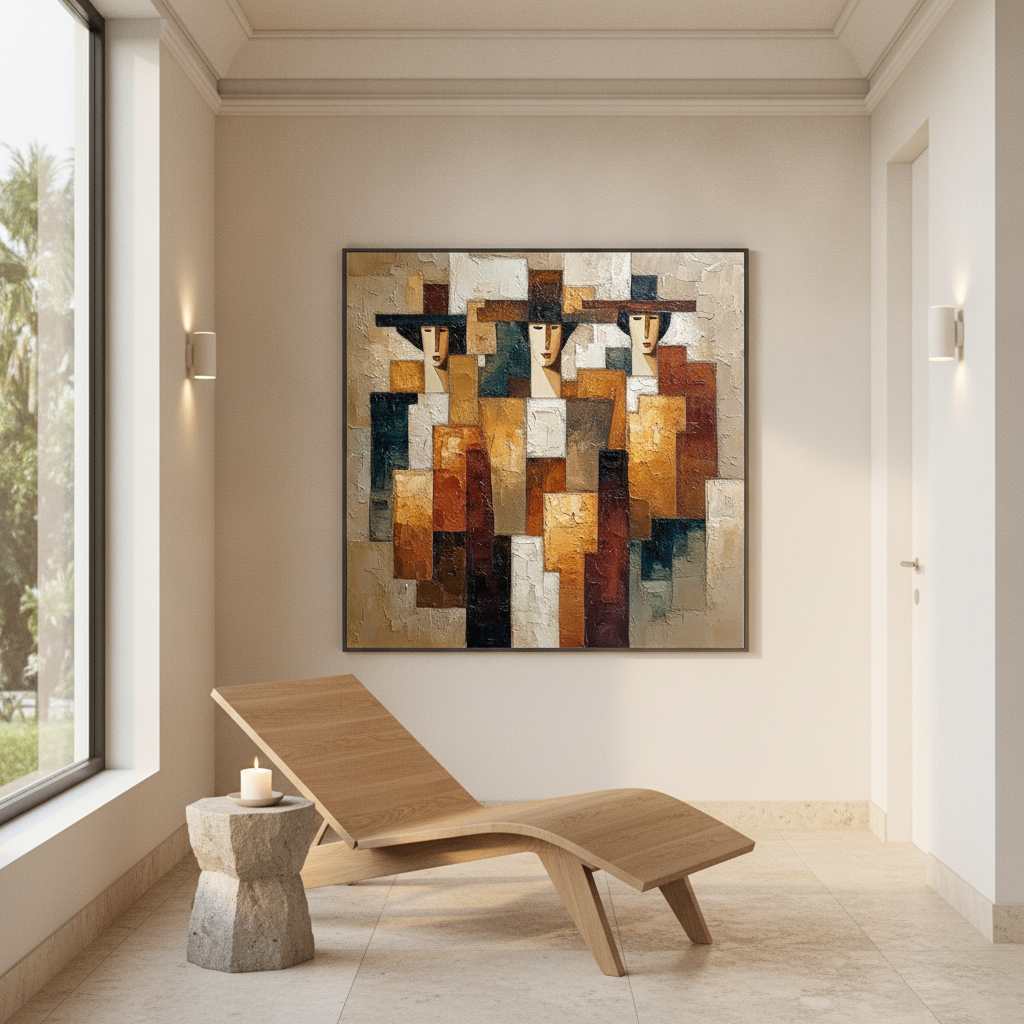
In a spa environment, "visual weight" is as impactful as color. This is where acrylic art outshines traditional prints. High-end wellness designers prioritize thick, hand-applied acrylic impasto because it provides a grounding, tactile quality.
According to research published in Sensors (MDPI), the microtopography (millimeter-scale texture) of a painting is crucial to its aesthetic and psychological impact. Tactile exploration—even when purely visual—reveals data that the brain misses in flat images. Tests at the MUNCH Museum confirm that art featuring physical relief textures exponentially stimulates intrinsic motivation and satisfaction in viewers.

Why Acrylics Over Oils for Spas?
While we often discuss mastery in oil gradients, acrylics are the pragmatic choice for high-humidity residential spas for three reasons:
- Moisture Resistance: Once cured, acrylics form a flexible, non-porous plastic film. Unlike oils, which can remain chemically active and susceptible to mold in humid zones, acrylics are highly stable.
- Curing Speed: Acrylics cure via "coalescence"—a physical process where water evaporates and polymer chains lock together. This is faster and more predictable than the oxidative cross-linking of oils.
- VOC Profile: Traditional oil solvents, such as turpentine or mineral spirits, emit high levels of Volatile Organic Compounds (VOCs). In a detoxification-focused spa, these odors and chemicals are counterproductive.
Safety First: The Chemical Reality of Pigments
For a space dedicated to wellness, "chemical safety" is non-negotiable. The EPA warns that indoor air pollution can be significantly more concentrated than outdoor pollution. Selecting low-VOC paints and sealants is a prerequisite for any healthy home environment.
The VOC Myth
A common misconception is that "odorless" means "non-toxic." Princeton University EHS guidelines warn that acute inhalation of high-concentration mineral spirits can cause central nervous system issues, even if the smell is faint. Acrylics generally offer a safer profile, but they are not entirely VOC-free. We typically observe that acrylic art can emit trace VOCs for 2-3 weeks post-application. For a "wellness-first" space, it is critical to allow for a full curing period before the room is used for deep-breathing exercises or heat therapy.
Heavy Metal Hazards
Beyond VOCs, the pigments themselves carry risks. Many traditional "artist-grade" colors contain heavy metals.
- Cadmium: The International Agency for Research on Cancer (IARC) classifies cadmium as a Group 1 carcinogen. While ECHA data suggests the environmental impact of artist paints is low compared to industrial fertilizers, the risk of dermal exposure or inhalation of dust remains a concern for residential safety.
- Lead: While largely phased out, EU REACH regulations strictly prohibit lead carbonate concentrations exceeding 0.1%.
When specifying art for a spa, we recommend choosing "Hue" alternatives (e.g., Cadmium Red Hue) which use modern synthetic organic pigments to mimic the color without the heavy metal load. This ensures the space remains a true sanctuary.
| Pigment Type | Common Heavy Metals | Wellness Alternative | Rationale |
|---|---|---|---|
| Traditional Whites | Lead (historically) | Titanium White | 90% market share, chemically inert (NCBI). |
| Bright Yellows/Reds | Cadmium | Azo or Pyrrole Hues | Eliminates carcinogenic risk; higher transparency. |
| Deep Blues | Cobalt | Ultramarine/Phthalo | Reduces potential for metal-induced toxicity. |
| Earth Tones | Manganese/Zinc | Iron Oxide (Synthetic) | More stable in high-humidity "spa" environments. |
Technical Mastery: Lighting and Metamerism
A serene palette that looks "healing" in a designer's studio can appear "muddy" or clinical once installed in a residential spa. This is due to metamerism—the phenomenon where two colors appear to match under one light source but differ under another.
The Kelvin Shift
Residential spas often use dim, warm relaxation lighting (2700K). However, adjacent grooming areas or vanities often utilize high-lumen, 5000K daylight LEDs. Acrylic pigments react differently to these shifts. For example, a "calming" lavender might turn a sickly grey under 5000K light if the pigment mix has high metameric instability.
To mitigate this, we utilize a "preview-and-approve" process. Seeing the art in the specific sensory context of the room is the only way to ensure aesthetic harmony. Designers should also consider the CIE 1976 Lab color difference equation* used in ASTM D4303 lightfastness testing to quantify how pigments will age and shift under the specific UV exposure of a sunlit spa.
Support Induced Discoloration (SID)
A technical "gotcha" for large-scale acrylic works is Support Induced Discoloration. As Golden Artist Colors notes, water-soluble impurities in cotton or linen canvases can be drawn into thick acrylic layers as they dry, causing a yellow or brown tint. In a spa where "purity" is the visual goal, this can be catastrophic. We recommend using high-quality, pre-primed canvases or non-porous supports to prevent this chemical migration.
Designing for 2026: Trends in Wellness Art
As we look toward 2026, home design is moving away from "assembly-line" decor. Zillow search data shows a 21% rise in mentions of "artisan craftsmanship" and a 15% rise in "whimsy." In high-end interiors, "texture" is becoming the soul of the room (Design State of Mind).
The "Powder Room" Escapism
One of the most significant trends identified at KBIS 2025 is the use of "panoramic murals" that wrap entirely around a room to create immersive escapism. For a residential spa, a hand-painted panoramic mural can transform a small recovery room into a vast, misty forest or a serene coastal horizon.
Ethical Luxury
High-net-worth buyers are increasingly socially conscious. Wharton School surveys found that 87% of consumers strongly agree that artists should receive fair compensation. By choosing hand-painted art over mass-produced prints, homeowners are not just buying an object; they are investing in the "creative economy," which accounts for 3.1% of global GDP (Creative Economy Outlook 2024).
Methodology Note: Trend Forecasting Our 2026 trend projections are based on a "Triangulation Model":
- Search Volume: Analyzing Zillow/Yelp keywords for "artisan" and "custom."
- Industry Awards: Reviewing KBIS and NKBA finalist palettes.
- Macro-Economics: Correlating the decline in "vanity auction art" with the rise in "home-as-sanctuary" spending.
- Boundary: These trends are most applicable to the "Luxury Wellness" segment and may not reflect mass-market retail patterns.
Long-Term Maintenance in High Humidity
To preserve the therapeutic value of art in a spa, maintenance must be proactive. While acrylics are durable, they are not invincible.
- Avoid Solvent Cleaning: Never use industrial solvents to clean art. Tate Modern research suggests that gently wiping with a water-based cotton swab is the safest way to remove dust without damaging the polymer film.
- UV Protection: Even indoor spas can have high UV exposure from windows or specialized lighting. A non-porous, UV-protective varnish is essential to prevent "chalking"—the breakdown of the acrylic binder over time.
- Humidity Control: Aim to keep the environment below 70% Relative Humidity (RH). As noted in ResearchGate ageing studies, high humidity can cause acrylic pigments to swell, potentially leading to delamination if the substrate isn't properly prepared.
Art as Wellness Infrastructure
Ultimately, the shift toward "Therapeutic Palettes" represents a deeper understanding of how our surroundings dictate our internal state. A hand-painted acrylic mural is more than decoration; it is a piece of "public health infrastructure" within the home. Whether it's the 18% boost in student academic scores seen in arts-rich environments (Americans for the Arts) or the 40% drop in neighborhood assaults linked to community murals (University of Michigan), the data is clear: art changes behavior and biology.
By prioritizing low-VOC materials, biophilic palettes, and the "essential identity" of human-made texture, you can ensure that your residential spa is a true recovery room—a space where the art works as hard as the therapy.
YMYL Disclaimer: This article is for informational purposes only and does not constitute professional medical, safety, or interior design advice. While art has been shown to have therapeutic benefits, it is not a substitute for clinical treatment. Always consult with a qualified professional regarding indoor air quality (IAQ) and chemical sensitivities, especially in enclosed or high-humidity environments.
Sources
- Marketplace: The expensive art market continues to struggle
- WHO: Scoping Review on Arts and Health
- NCBI: Neurological mechanisms of creative arts
- Columbia University: Human-Made vs. AI Art Study
- EPA: Indoor Air Quality and Low-VOC Paints
- UCA: Biophilic Design and Well-being
- Golden Artist Colors: Support Induced Discoloration
- ASTM International: Lightfastness Standards