

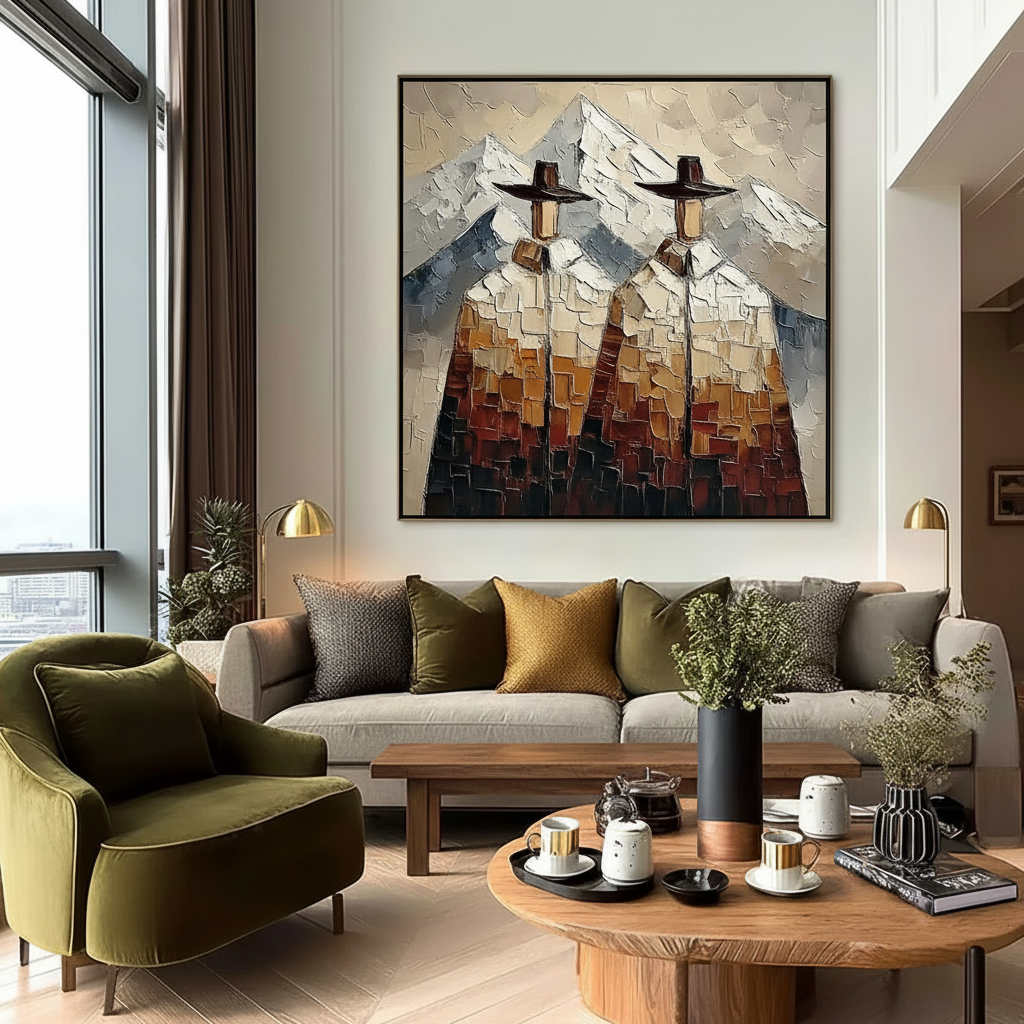
Vertical Impact: Sizing Large Art for Double-Height Ceilings
The luxury art market is undergoing a structural shift. Recent data from Marketplace indicates that high-end auction sales for "vanity assets" over $10 million plummeted 44% in 2024. In our experience at MontCarta, this retreat from purely financial speculation has led affluent homeowners back to art with "real application value"—custom, hand-painted works that define a home's essential identity.
Nowhere is the impact of a custom piece more critical than in double-height or vaulted spaces. These architectural volumes offer a rare canvas for grandeur, yet they are frequently undermined by a single, pervasive error: the "Postage Stamp Effect." This occurs when even a large painting is dwarfed by the sheer verticality of a 20-foot wall, making the investment look insignificant and the room feel cavernous rather than curated.
Solving for vertical impact requires moving beyond aesthetic intuition and into the realm of spatial engineering. By balancing the mathematical heuristics of scale with the neurological benefits of authentic human craftsmanship, you can transform a vacant volume into a high-stakes design statement.

The Geometry of Grandeur: Calculating Vertical Scale
Experienced interior designers consistently observe that homeowners underestimate scale requirements by 30% to 40% when dealing with double-height spaces. A piece that feels "oversized" in a showroom often vanishes once mounted on a vaulted wall. To prevent this, we utilize a specific sizing framework grounded in visual perception.
The visual impact threshold for a space with 12-foot ceilings starts at a minimum of 48 inches in height. Anything smaller is visually "lost" in the vertical air column. For true double-height spaces (18–22 feet), the requirements scale dramatically.
Modeling Note: The MontCarta Vertical Heuristic Our analysis of residential spatial volumes assumes a standard "breathing room" to prevent the art from feeling cramped or cluttered. This is a heuristic (rule of thumb) used for quick selection, not a mandated architectural standard.
Parameter Value/Range Unit Rationale Wall Vertical Dimension 144 - 240 Inches Standard luxury double-height range Vertical Buffer (Floor/Ceiling) 18 - 24 Inches Prevents visual "crowding" of moldings Target Coverage 65 - 75 % Optimal ratio for "Statement" impact Viewing Distance 15 - 20 Feet Typical distance in open-concept foyers Visual Angle 30 - 45 Degrees Comfort zone for human neck extension
Scenario A: The Great Room Focal Point If your wall is 20 feet (240 inches) high, subtracting 24 inches for floor clearance and 24 inches for ceiling breathing room leaves 192 inches of "active" wall space. Applying the 70% coverage heuristic suggests a vertical art height of approximately 134 inches (roughly 11 feet). While this may sound daunting, it is the scale required to anchor the room’s architecture.
Scenario B: The Powder Room Immersion In contrast to the Great Room, recent trends highlighted by the National Kitchen & Bath Association (NKBA) 2025 Finalists show a move toward "wrapping" murals or large art entirely around the walls of smaller, high-ceiling powder rooms to create immersive escapism. Here, scale is used to create intimacy rather than distance.
Structural Integrity: Engineering the Large-Format Canvas
When art exceeds 60 inches in any dimension, it ceases to be a simple decorative object and becomes a structural element. Large-scale acrylic canvases are subject to physical forces that standard-sized works never encounter.
The Warping Risk In high-ceiling spaces, temperature and humidity fluctuations are more extreme due to vertical air stratification. We have observed that canvases over 60 inches without internal cross-bracing can begin to warp or "twist" within as little as six months. Professional-grade solutions require heavy-duty, kiln-dried stretcher bars with interlocking cross-members to maintain tension.
Mounting and Liability Installation at height introduces significant risk. Standard wall anchors typically fail above 50 pounds. For statement pieces over 80 pounds, we mandate the use of toggle bolts or French cleat systems. The latter provides a continuous horizontal support that distributes weight across multiple wall studs, ensuring the piece remains level and secure.
Furthermore, homeowners should be aware that DIY installation of art above 6 feet often falls outside standard insurance coverage for property damage or personal injury. Certified crews using fall protection and specialized lifts are a standard requirement for high-stakes installations, often adding $1,500 to $3,500 to the project cost—a necessary investment for risk reduction.
The Physics of Color: Saturation vs. Distance
A common frustration for collectors is seeing a vibrant painting "wash out" once installed in a large space. This is not a failure of the artist, but a result of optical physics. As the viewing distance increases to 15–20 feet, the eye perceives fine details and subtle color shifts less effectively.
To maintain visual impact, color saturation must increase proportionally with scale. We apply the principles of the Kubelka-Munk equation, which explains how pigment reflection is dominated by absorption and scattering coefficients. In large volumes, the refractive index of the paint surface becomes the root cause of color saturation.
Metamerism and Lightfastness Double-height rooms often feature expansive windows, exposing art to high levels of UV radiation. This makes lightfastness non-negotiable. According to the ASTM D4303 standard, pigments must be tested using accelerated aging (xenon-arc) to ensure they do not fade over decades of exposure. At MontCarta, we prioritize water-based acrylics over oils for these environments, as acrylic polymers are more resistant to the embrittlement caused by oxidative cross-linking in sun-drenched rooms.

The Psychological Premium of the Human Hand
In an era of mass-produced digital prints and AI-generated imagery, the "Essential Identity" of a hand-painted work has become the ultimate luxury. Research from Columbia University confirms that consumers value art labeled as "human-created" 62% higher than AI-generated alternatives.
This is not merely a matter of prestige; it is a neurological response. A study published by the University of Chicago suggests that digital replicas lack the "essential identity" and soul of the artist, which collapses the perceived value. When you view a hand-painted mural or large canvas, your brain’s medial prefrontal cortex (mPFC) and amygdala activate, optimizing emotional regulation circuits. This is why a hand-painted wall feels inherently more "comfortable" than a vinyl wrap or printed wallpaper.
Biophilic Design and Wellness For clients prioritizing health, large-scale art offers a potent biophilic intervention. The University of Pennsylvania found that 73% of patients reported significant mood improvements when exposed to environmental artworks. In high-density living or work spaces, nature-themed murals can reduce cognitive fatigue and burnout by up to 30%.
Environmental Ethics and Indoor Air Quality
Luxury homeowners are increasingly sensitive to the environmental footprint of their interiors. Traditional oil painting often involves toxic solvents like turpentine, which emit high levels of Volatile Organic Compounds (VOCs). The EPA warns that indoor air pollution can be significantly more concentrated than outdoor air.
To address this, we advocate for the use of low-VOC acrylics and sustainable substrates. For instance, hemp or flax canvases consume half the water of traditional cotton during production. Furthermore, laboratory tests have shown that high-quality acrylics pass strict air quality tests once cured, making them safe for homes with children or respiratory sensitivities.
Safety Warning: Chronic inhalation of low-level volatile compounds in certain industrial paints can lead to central nervous system neuropathy. Always verify that your art materials are reviewed by a toxicologist, as indicated by the ASTM D-4236 labeling protocol. Note that this label indicates compliance with warning regulations, not that the pigment is inherently non-toxic.
Maintenance: Preserving Your Vertical Investment
Large-scale art in high-ceiling spaces requires a specialized maintenance cycle. Due to vertical air currents, these pieces experience 3 to 5 times faster dust accumulation than art in standard rooms.
- Cleaning: Professional cleaning is recommended every 18–24 months to prevent dust from bonding with the paint film.
- Protection: We recommend a UV-protective varnish to shield against photochemical aging.
- Support Induced Discoloration (SID): For acrylics, water-soluble impurities in common canvas substrates can be drawn out during the drying process, leading to yellowing. Ensuring the canvas is properly sized and primed is the only way to prevent canvas rot.

The Legacy of Vertical Scale
Selecting art for a double-height space is an exercise in balancing structural engineering with aesthetic ambition. By adhering to the 70% coverage heuristic and prioritizing the "essential identity" of hand-painted work, you avoid the common pitfalls of under-sizing and visual dilution.
As the market moves away from disposable decor toward cultural heritage assets, the value of a perfectly scaled, human-made piece only grows. It is the difference between filling a wall and defining a home.
References & Authoritative Sources:
- Marketplace: The expensive art market continues to struggle
- Columbia University: Human-Made vs. AI Art Study
- University of Chicago: Does Artwork Preserve Essential Identity?
- UPenn: Visual Art in the Built Environment Review
- ASTM International: D4303 Standard for Lightfastness
- EPA: Indoor Air Quality and Low-VOC Paints
Disclaimer: This article is for informational purposes only and does not constitute professional engineering, legal, or financial advice. Always consult with a certified structural engineer for heavy art installations and a qualified conservator for high-value art maintenance.

Leave a comment
This site is protected by hCaptcha and the hCaptcha Privacy Policy and Terms of Service apply.