

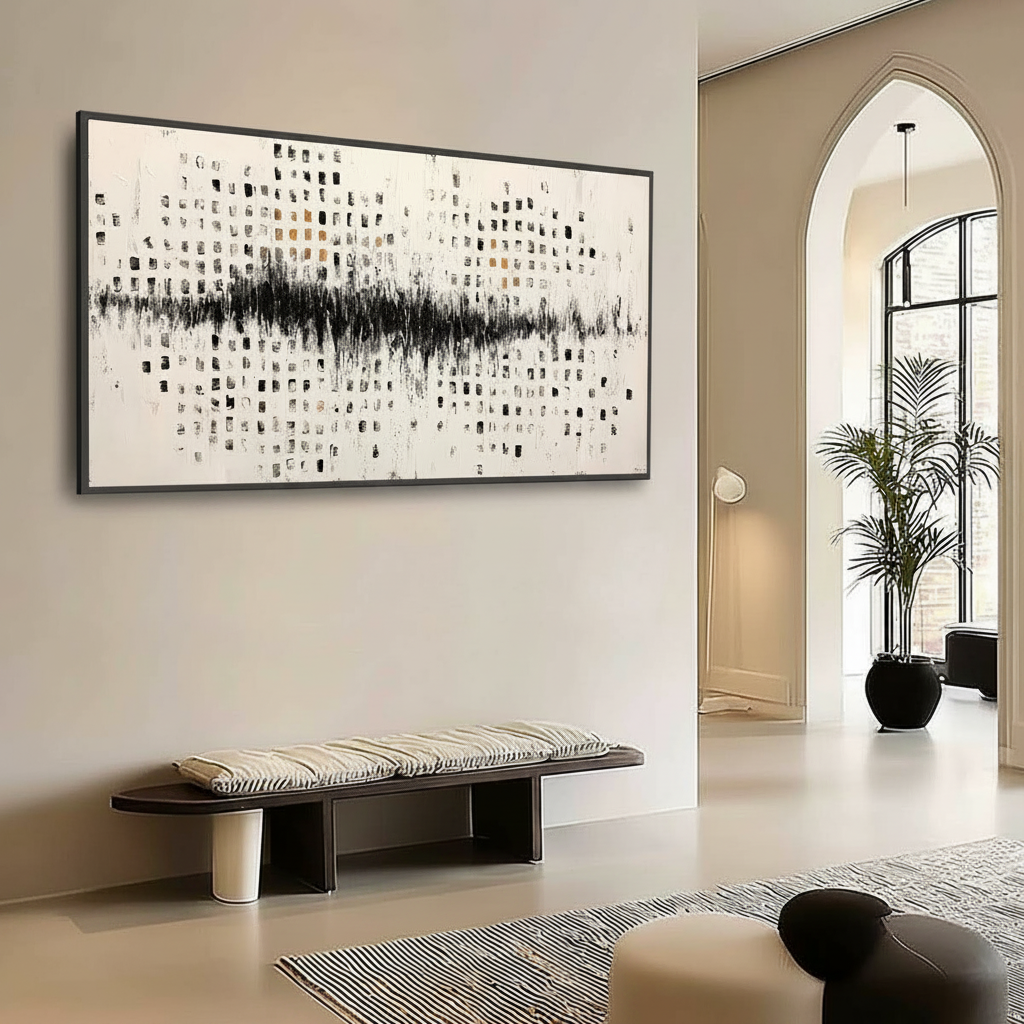
The Engineering of Elegance: Why Stretcher Depth Matters
In the evolving landscape of high-end interior design, the shift away from mass-produced digital prints toward authentic, hand-painted statement pieces is measurable. While the expensive auction market for vanity assets has seen a retreat—with sales over $10 million plummeting 44% in 2024 according to Marketplace—consumers are returning to "real application value." This is particularly true for large-scale acrylic works, where the physical presence of the medium offers a sensory depth that AI-generated art cannot replicate. In fact, research from Columbia University confirms that consumers value art labeled as human-created 62% higher than AI-generated alternatives.
However, for design-conscious homeowners and professionals, commissioning a large-scale work involves more than aesthetic selection; it requires an understanding of structural engineering. A common mistake in the industry is treating a 60-inch canvas with the same structural assumptions as a small gallery piece. When you transition to large formats, the weight of professional-grade acrylic pigments and the physics of canvas tension transform the stretcher bar from a simple frame into a load-bearing architectural element.
Choosing the right depth—the "profile"—of your stretcher bar is not merely a stylistic choice for a "gallery wrap" look; it is a prerequisite for the long-term survival of the artwork.

The Hidden Physics of Acrylic Weight
A frequent misconception in the art world is that acrylic is a "lightweight" alternative to oil. While this may be true for thin washes, professional-grade acrylics are high-density systems. According to research into paint density, professional acrylic formulations incorporate heavy pigments like cadmiums, iron oxides, and fillers such as calcium carbonate, which can push the effective density to 1.4–1.6 g/cm³.
In our conservation observations, we find that a heavily layered 48x60" canvas can easily exceed 15 to 20 pounds of added weight from the paint film alone. This isn't just a static load; it’s a dynamic one.
The Shrinkage Factor
Unlike oil paint, which cures through oxidative cross-linking, acrylics form a film through "coalescence." As the water evaporates, the polymer chains draw together. This process results in a volume shrinkage of 5% to 15%. For a large-scale work, this shrinkage creates a continuous inward "pull" on the stretcher bars. If the bars are too thin, this tension—combined with the sheer mass of the pigment—leads to structural failure.
Modeling Note (Scenario Analysis): Our structural estimates are based on a deterministic model for large-format canvases (48"x60") using professional-grade heavy-body acrylics.
Parameter Value/Range Unit Rationale Acrylic Density 1.4 - 1.6 g/cm³ High-pigment load (Iron Oxides/Cadmiums) Impasto Thickness 3 - 5 mm Standard "heavy texture" application Volume Shrinkage 5 - 15 % Standard polymer coalescence Load at Center 18 - 24 lbs Estimated for 48x60" heavy impasto Critical Span 36 inches Threshold for standard 3/4" bar failure
Why the 1.5-Inch Profile is the Professional Baseline
For any canvas where the shortest side exceeds 36 inches, the industry-standard ¾" "studio profile" becomes a liability. At this scale, the wood lacks the sectional modulus to resist the combined forces of canvas tension and paint weight.
The transition to a 1.5-inch (or deeper) profile provides two critical advantages:
- Torsional Rigidity: Deeper bars are significantly more resistant to "twisting." Large canvases often develop a "propeller" warp if the wood isn't thick enough to counteract the uneven tension of hand-stretched fabric.
- Center Sag Prevention: On a large vertical span, gravity pulls the weight of the acrylic toward the center. Without the rigidity of a deep profile and proper cross-bracing, the canvas will begin to "belly" or sag within months. We have observed that for heavy impasto applications on 48x60" canvases, even the common 1.5" recommendation can be inadequate without internal support.
The "Moment Arm" Paradox
It is important to note a subtle engineering "gotcha": while deeper bars are more rigid, they also create a longer "moment arm" at the corner joints. This means the stress at the staples and the mitered corners is actually multiplied. For this reason, deep-profile bars must be constructed from kiln-dried hardwoods or finger-jointed pine to ensure the joints don't splay under the increased leverage.

The Necessity of Cross-Bracing
Beyond a certain size, the perimeter bars cannot do the job alone. For pieces over 60 inches, cross-bracing is non-negotiable. The professional standard is to include one horizontal or vertical brace for every 24 to 30 inches of span.
Structural failures in large art rarely occur at the corners first. Instead, they manifest along the center of the long spans where the wood bows inward under the tension of the drying acrylic. This bowing causes the canvas to lose its "drum-tight" feel, leading to ripples in the paint film that can eventually crack.
Furthermore, environmental cycling plays a role. As noted in Aalto University's chamber experiments, moisture levels in wood and canvas fluctuate. Acrylic is hygroscopic; it absorbs moisture from the air, causing seasonal tension variations. A robust, braced frame acts as a skeletal system that absorbs these micro-movements without transferring the stress to the delicate paint surface.
Aesthetic Intentionality: The "Object" vs. The "Window"
Choosing a deeper stretcher bar also changes the relationship between the art and the room.
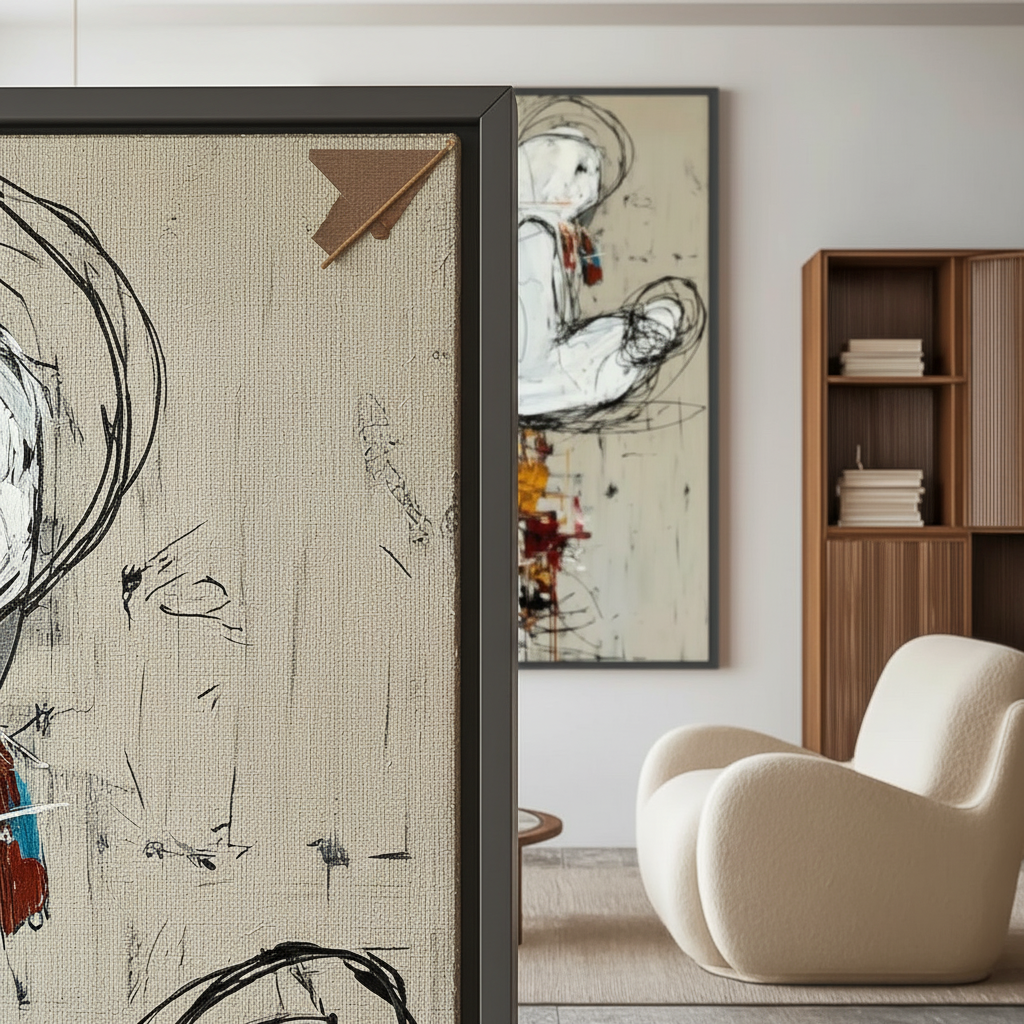
- The 1.5" to 2.5" Profile: This creates a sculptural, "object-like" presence. It signals that the work is a significant architectural feature. In modern minimalist interiors, this depth allows the painting to hold its own against high ceilings and expansive walls without the need for an external decorative frame.
- The 3/4" Profile: This is typically reserved for works that will be placed into a "floater frame" or a traditional ornate frame. On its own, a large, thin canvas can look "flimsy" or unintentional, like a temporary installation rather than a permanent investment.
For high-end residential and commercial spaces, the "Museum Profile" (2" to 2.5") is increasingly popular. It provides the maximum structural safety margin while offering a bold, contemporary aesthetic that complements the "understated elegance" trends predicted for 2026 by Design State of Mind.
Installation: Managing the Load
Once you have selected a deep-profile stretcher to support the weight of the acrylic, the final hurdle is the wall itself. Standard picture hooks are often rated for 20–30 pounds, which may seem sufficient. however, the concentration of weight in a large-scale piece creates a high "pull-out" force on the top edge.
For pieces exceeding 50 pounds per square foot at the anchor points, we recommend upgrading to French Cleats. A French cleat distributes the weight across the entire width of the frame and secures it to multiple wall studs. This prevents the "bowing" of the top stretcher bar that can occur when a heavy painting is hung from a single wire.
In commercial environments, such as luxury hotel lobbies or corporate offices, this structural integrity is a prerequisite for safety and LEED/WELL certification, ensuring that the installation remains secure in high-traffic areas.

Investing in Longevity
As the global creative economy reaches record highs—with creative services exports hitting $1.4 trillion according to UNCTAD—the value of hand-painted art as a stable economic and emotional asset is clear. However, that value is only preserved if the work remains physically intact.
When commissioning or purchasing large-scale acrylic art, view the stretcher bar not as a hidden accessory, but as the foundation of the piece. By choosing a depth that accounts for the density of the pigment, the tension of the curing polymer, and the demands of the environment, you ensure that your investment remains as vibrant and structurally sound decades from now as it is on the day of installation.
For more insights on maintaining the integrity of your collection, explore our guides on preventing canvas rot and balancing textured art with minimalist decor.
Disclaimer: This article is for informational purposes only. Large-scale art installations involve significant weight and structural considerations. Always consult with a professional art handler or structural engineer for mounting pieces in public or high-traffic areas to ensure compliance with local safety codes.

Leave a comment
This site is protected by hCaptcha and the hCaptcha Privacy Policy and Terms of Service apply.