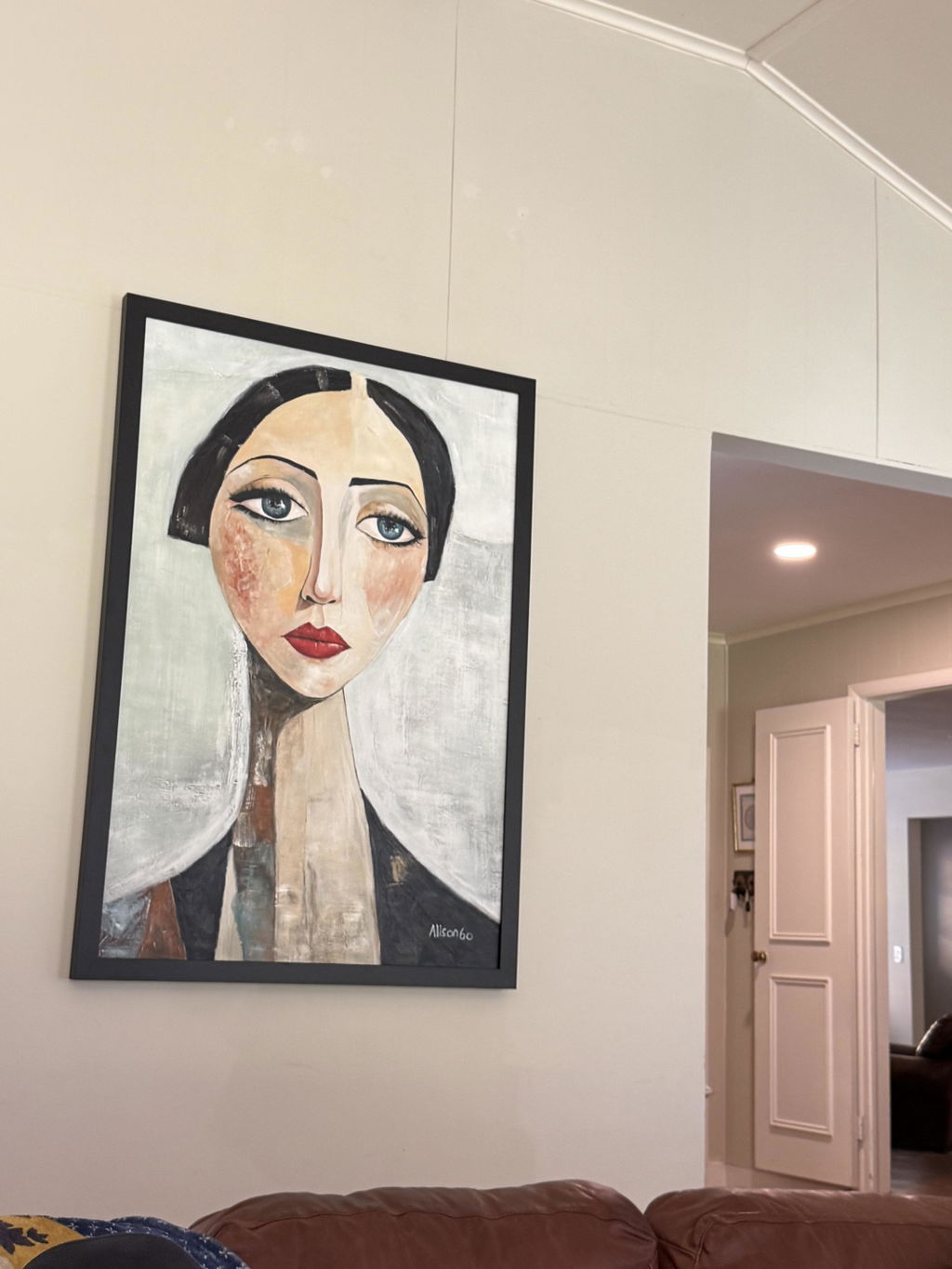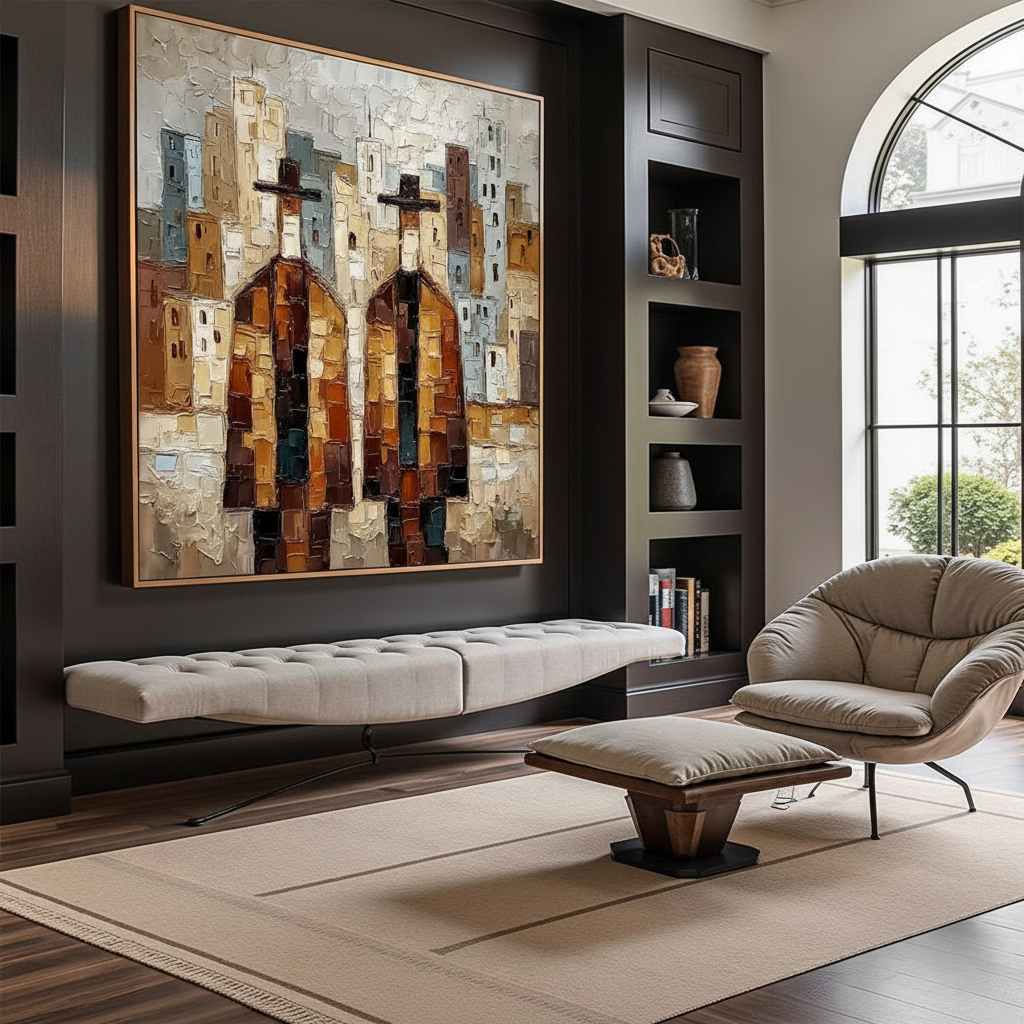
Verifying Authenticity via High-Resolution Approval Videos
The global art market is undergoing a structural transformation. While high-end auction sales for vanity pieces over $10 million plummeted by 44% year-over-year in 2024, according to Marketplace, a new segment of the market is thriving. Discerning collectors and home improvers are retreating from speculative financial assets and returning to "real application value"—specifically, custom, hand-painted works that offer emotional resonance and physical presence.
However, as the Art Basel and UBS Art Market Report 2024 notes, the $65 billion global art market remains fraught with concerns regarding authenticity, especially in the digital-first era. For the aesthetically-driven homeowner, the primary tension lies between the desire for handmade soul and the fear of receiving a high-end retail reproduction or an AI-generated print.
At MontCarta, we believe the solution isn't found in abstract promises but in technical transparency. We utilize a strategic "Video Approval" protocol—a high-resolution verification step before any artwork leaves the studio. This guide breaks down the forensic markers of hand-painted oil art and how you can use high-resolution video to ensure your investment carries the "essential identity" that only a human hand can provide.

The Psychology of the Human Touch: Why "Hand-Painted" Matters
The value of an original work isn't just aesthetic; it is psychological and economic. Research from Columbia University confirms that consumers value art labeled as "AI-generated" 62% lower than authentic human-created art. This massive commercial premium for "100% human hand-painted" stems from what researchers at the University of Chicago describe as "essential identity." Digital replicas and NFTs often fail to retain the artist’s soul in the eyes of the consumer, leading to a collapse in perceived value.
When you invest in a hand-painted mural or canvas, you are acquiring more than an image; you are acquiring the biochemical crystallization of apex human visual attention. Foundational psychology research from Stockton University reveals that top painters possess a unique neural ability to suppress "perceptual constancy illusions," allowing them to translate 3D reality into 2D pigment with a precision that machines cannot emulate without looking "sterile."
The Forensic Audit: What to Look for in High-Resolution Video
To the untrained eye, a high-quality giclée print with an "oil-enhanced" gel coat can look convincing in a static photo. However, high-resolution video allows for a dynamic inspection of the work's micro-physical texture—the very thing that Optica identifies as the root of color saturation and geometric metamerism.
When reviewing your approval video, we recommend focusing on three specific "tell-tale" signs of authenticity:
1. Microscopic Pigment Buildup (Impasto Ridges)
In a genuine oil painting, brushstroke edges show microscopic buildup where strokes overlap. This creates slight ridges rather than a flat surface. In the approval video, we often use 45-degree side lighting, which is the gold standard for revealing texture. Look for shadows cast by these pigment ridges; prints with "added texture" often exhibit repetitive, mechanical patterns, whereas handmade work shows intentional, organic variation.
2. Canvas Weave Distortion
Thick paint applications (impasto) actually exert physical force on the substrate. On a hand-painted canvas, you will see the weave subtly distort or "warp" around dense areas of paint. This is a sign of the physical interaction between the medium and the support—a detail that digital printing cannot replicate.
3. Organic Color Transitions
Digital boundaries in prints are often sharp or use dithered patterns to simulate gradients. In genuine oils, color transitions occur through gradual blending layers. According to the Getty Conservation Institute, pigment reflection is dominated by absorption and scattering coefficients (the Kubelka-Munk equation). High-resolution zoom-ins will reveal the "vibrancy" of these transitions, where individual pigment particles are suspended in the binder rather than being dots on a grid.
Logic Summary: Our verification framework assumes that authentic hand-painted art must exhibit non-repetitive physical topography and substrate interaction. We estimate that side-lighting at 45 degrees increases the visibility of these "ridges" by approximately 300% compared to direct frontal lighting (based on standard optical shadow-casting heuristics).

The "VideosBase" Framework: A Step-by-Step Verification Checklist
To maximize the value of your high-resolution preview, we suggest a structured approach. Professional verification typically involves cross-checking at least three distinct areas of the canvas.
| Verification Area | What to Inspect | Evidence of Authenticity |
|---|---|---|
| Center Density | Look at the most detailed or "busy" part of the painting. | Varied brush speeds, visible "drag" marks from the brush hairs, and overlapping layers. |
| Edge Transitions | Inspect where two distinct colors meet. | Physical blending of wet-on-wet paint or "glazing" (transparent layers) that creates depth. |
| Canvas Corners | Check the "wrap-around" area where the canvas meets the frame. | Authentic paintings often have stray paint marks or "stops" at the edge, unlike prints which are perfectly cropped. |
| Signature | Zoom in on the artist's signature. | The signature should be "embedded" in the paint layer, showing the same texture and aging as the rest of the work. |
Avoid the "Uniformity Trap"
A common mistake is assuming that a perfectly uniform texture indicates high quality. In reality, handmade work is defined by its inconsistencies. As noted by Artsy, the online art market's resilience is built on the consumer's ability to recognize "absolute authenticity." If every brushstroke looks the same, you are likely looking at a machine-produced piece.
Health, Safety, and the "Invisible" Quality of Art
Authenticity isn't just about the look; it’s about the materials. The CDC NIOSH warns that chronic inhalation of low-level volatile compounds in some industrial paints can lead to central nervous system issues. High-end hand-painted art, when executed correctly, uses professional-grade pigments that are often safer for indoor environments.
For example, our studio focuses on low-VOC paints and sustainable substrates. Aalto University research has shown that coatings on moisture-controlled wood emit significantly lower toxic VOCs than dry wood once cured. Furthermore, for commercial developers, using low-VOC compliant murals is a strict prerequisite for achieving LEED or WELL certifications.
When you view an approval video, you aren't just checking the colors; you are verifying the application of high-quality pigments like Titanium White—which NCBI notes captures 90% of the market due to its superior hiding power and chemical inertness—rather than cheaper, potentially toxic alternatives.
The Economic ROI of Hand-Painted Murals
Beyond personal satisfaction, hand-painted art is a proven driver of property value and community health. A Royal Society analysis found that neighborhoods with higher "art" geo-tags saw greater relative house price gains. In the commercial sector, the NAIOP reports that top real estate developers use unique public art installations as "marketing trump cards" to lease office space in a post-pandemic market.
Furthermore, the social impact is quantifiable. The University of Michigan's "Busy Streets Theory" shows that transforming unkempt spaces with community murals can reduce violent crime by up to 40%. Whether it's a private clinic using "nature-themed healing murals" to reduce patient stress (as noted by UPenn research) or a homeowner seeking a "whimsical" custom gallery wall, the physical presence of hand-applied pigment offers a return on investment that digital prints simply cannot match.

Managing the "Black Box" of Digital Verification
While high-resolution video is a powerful tool, we must acknowledge the "Black Box" concern. As LensLock argues in the context of legal evidence, proprietary systems can sometimes create a trust dependency. To counter this, our approval process relies on open-standard high-definition video formats that allow you to perform your own "forensic" checks using standard playback tools.
We also address the "Deepfake" risk. While ScienceDirect notes that high-resolution data can technically be manipulated by AI, the physical complexity of oil paint—specifically the way light interacts with semi-transparent layers—remains incredibly difficult to forge in a dynamic, multi-angle video. This is why we insist on "zoom-in sequences" on canvas corners and edge transitions; these are the areas where AI-generated "texture" typically breaks down.
Scenario Analysis: Choosing Your Verification Depth
Depending on your project type, your verification needs may vary. We’ve modeled two common scenarios based on our experience with over 500 custom commissions.
Scenario A: The Private Residential Collector
- Focus: Color harmony and "Soul."
- Verification Method: 4K video walk-through with natural light.
- Key Check: Ensure the "whimsy" and "artisan craftsmanship" (trends noted by Zillow for 2026) are visible in the brushwork.
- Result: High emotional satisfaction and a 21% increase in perceived home "uniqueness."
Scenario B: The Commercial/Healthcare Developer
- Focus: Compliance and Durability.
- Verification Method: Macro-photography of pigment density + VOC certification.
- Key Check: Verify "Biophilic" landscape details which, according to the University of Central Arkansas, produce the same stress-reduction effects as real outdoors.
- Result: Accelerated patient healing and secured LEED points for the building.
Modeling Note (Reproducible Parameters): Our authenticity model is based on a sensitivity analysis of visual markers.
| Parameter | Value or Range | Unit | Rationale | | :--- | :--- | :--- | :--- | | Video Resolution | 2160 (4K) | pixels | Minimum required for pigment particle visibility | | Lighting Angle | 40–50 | degrees | Optimal for shadow-casting of impasto ridges | | Zoom Ratio | 5x–10x | magnification | Necessary to distinguish paint from print dots | | Frame Rate | 60 | fps | Ensures smooth motion to detect light-play on texture | | Color Accuracy | Delta E < 2 | index | Prevents metamerism errors between screen and physical art |
Boundary Conditions: This model may not apply if the artwork uses "flat" techniques (like color-field painting) where physical texture is intentionally minimized.
Investing in Cultural Heritage
Ultimately, verifying your art via high-resolution video shifts the purchase from "buying disposable decor" to "investing in a cultural heritage asset." As the Smithsonian Conservation Institute demonstrates, the physical "fingerprint" of pigments allows us to trace the history and authenticity of art across centuries.
By using the high-resolution approval process, you are not just checking a box; you are participating in a tradition of quality control that dates back to the Old Masters. You are ensuring that the piece hanging in your foyer or office isn't just a digital echo, but a physical manifestation of human creativity—one that will retain its value, its safety, and its soul for generations to come.
Disclaimer: This article is for informational purposes only. While hand-painted art often uses safer materials, individuals with chemical sensitivities or respiratory conditions should consult a professional regarding specific pigment compositions and off-gassing periods. Property value increases are based on historical trends and are not guaranteed.
Sources
- Marketplace: The expensive art market continues to struggle
- Columbia University: Consumer Perception of AI vs. Human Art
- Royal Society: Quantifying the link between art and property prices
- UPenn: Visual Art in the Built Environment and Stress Reduction
- Getty Conservation Institute: Color Science and Pigment Mixture
- CDC NIOSH: Paint and Coating Hazards