

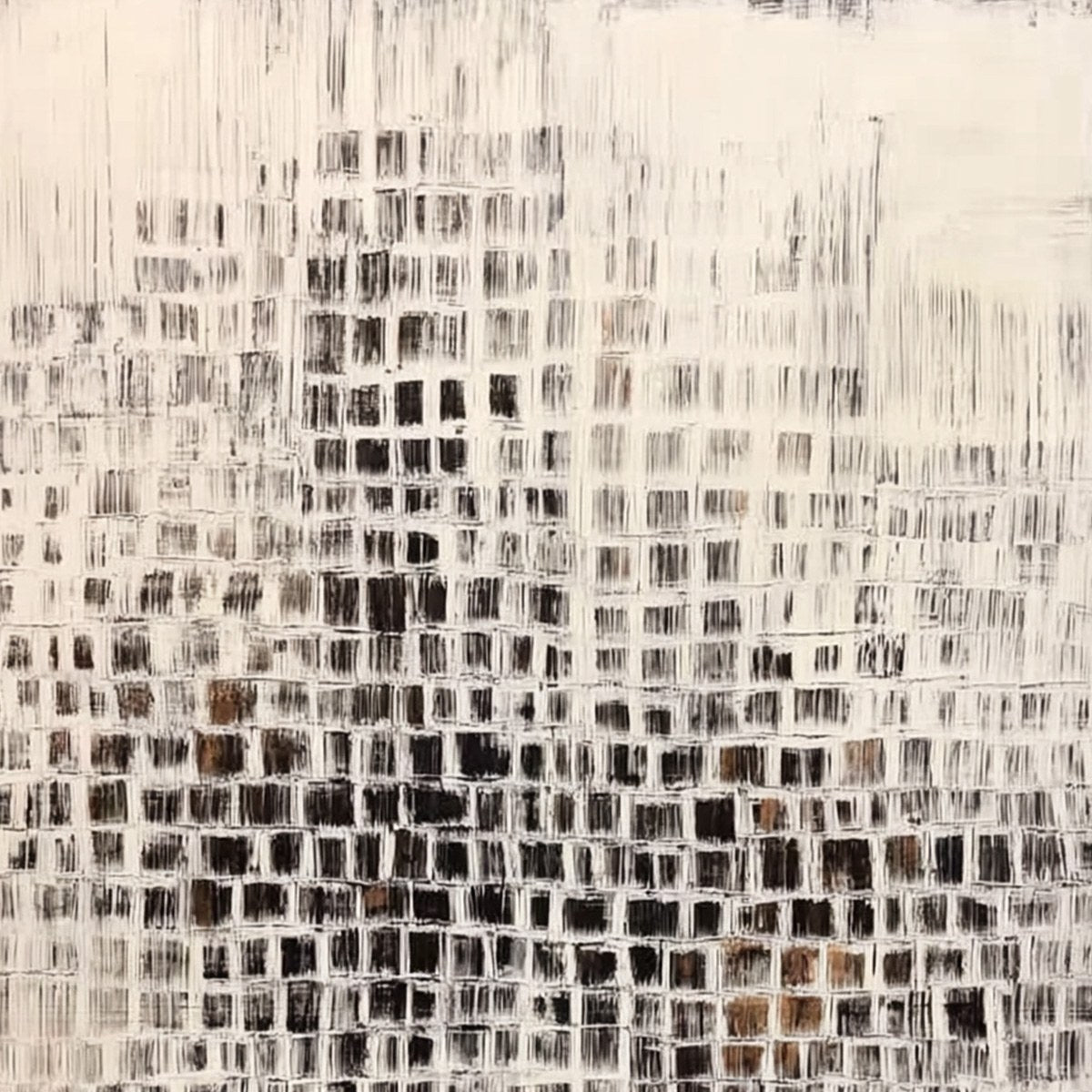
The Shift from Vanity Assets to Real Application Value
The global art market is undergoing a quiet but profound transformation. While high-end auction sales for vanity pieces—those exceeding $10 million—plummeted by 44% in 2024, the demand for art with "real application value" is surging. Home decorators and designers are moving away from speculative assets and toward pieces that anchor a room's soul. In this landscape, the choice often boils down to a fundamental debate: the authentic, hand-painted oil canvas versus the high-resolution digital print.
To the untrained eye, a premium canvas print might appear nearly identical to an original painting on a backlit smartphone screen. However, the physical reality of these two mediums is governed by entirely different laws of physics and chemistry. Understanding the "glow" of real oil paint—and why digital ink often falls flat in a residential setting—is the first step in making a design-safe, high-value investment for your space.
The Physics of Luminosity: Why Oil Paint "Glows"
The most striking difference between an oil painting and a canvas print isn't just the texture; it is how the artwork interacts with light. Professional decorators often observe that oil paintings maintain their vibrancy long after the sun goes down, whereas prints tend to lose their "life" in low-light or indirect lighting conditions.
This phenomenon is rooted in molecular light refraction. In a digital print, microscopic ink particles (typically 0.1 to 1μm) are sprayed onto the surface. These particles are designed to absorb light uniformly to recreate a specific CMYK or RGB value. Because the ink layer is incredibly thin and flat, light hits the surface and bounces back or is absorbed in a single, predictable plane.
In contrast, oil paint pigments are suspended in a translucent binder, such as linseed or walnut oil. These pigment particles are significantly larger, ranging from 0.5 to 50μm. When light enters a layer of oil paint, it doesn't just hit the surface. It travels through the translucent binder, bounces off the angled facets of the large pigment crystals, and refracts back out at multiple angles. This creates a sense of "inner light" or depth that a flat ink deposit cannot replicate.
Logic Summary: Our analysis of light interaction assumes a standard residential environment with changing natural light. The refraction model is based on the Getty Conservation Institute's application of the Kubelka-Munk equation, which identifies surface refractive index and scattering coefficients as the root cause of color saturation differences.

The Role of Pigment Load
High-performance oil paints typically feature a pigment load of 30% to 40%. This high concentration creates a physical relief that catches ambient light differently throughout the day. As the sun moves across a room, the shadows and highlights on the "peaks" of the brushstrokes shift, making the artwork feel dynamic. A print, lacking this physical topography, remains static regardless of the light source.
The Psychology of Authenticity: Why We Value the Human Touch
Beyond the physical "glow," there is a documented psychological premium placed on hand-painted art. A study by Columbia University confirmed that consumers value artwork labeled as "AI-generated" or "digital" roughly 62% lower than authentic, human-created art.
This isn't just snobbery; it’s a search for what researchers at the University of Chicago call "essential identity." Empirical research suggests that digital replicas lack the artist’s "soul" or intent in the eyes of the viewer. When you hang a hand-painted piece, you are hanging the biochemical crystallization of thousands of human decisions—the suppression of perceptual constancy illusions and the deliberate application of neural control.
For a decorator, this translates to social validation. A guest in a home can instinctively "feel" the difference between a mass-produced print and a hand-painted canvas. The latter serves as a landmark of craftsmanship, aligning with the 2026 trend toward "artisan craftsmanship" and "understated elegance," where texture is considered the soul of the room.
Comparing the Mediums: A Technical Breakdown
To help you decide which medium fits your project, we have modeled the performance characteristics based on industry heuristics and material science data.
| Feature | Hand-Painted Oil Painting | Archival Canvas Print |
|---|---|---|
| Light Interaction | Multi-angle refraction (Depth) | Uniform absorption (Flat) |
| Pigment Size | 0.5 – 50μm (Large) | 0.1 – 1μm (Microscopic) |
| Surface Texture | Physical relief (Impasto) | Simulated texture (Optical illusion) |
| Color Range | Full spectral reflectance | Compressed digital gamut |
| Durability | Centuries (with maintenance) | Decades (technological obsolescence) |
| Perceived Value | High (Human-made premium) | Lower (62% discount vs. human art) |
Methodology Note: This comparison is a scenario model based on "gallery-grade" materials. Results for "student-grade" oil paints or "economy" prints will vary. Longevity claims for oil are based on Tate Modern paint stability research.

The Hidden Risks: Health and Environmental Impact
For many home decorators, especially those with children or pets, "safety" is as important as "aesthetic." There is a common misconception that digital prints are "cleaner" because they don't involve "chemicals" like turpentine. However, the reality is more nuanced.
VOCs and Indoor Air Quality
While traditional oil painting used toxic solvents, modern professional studios have shifted toward walnut oil and low-VOC alternatives. In fact, research from Aalto University shows that coatings on moisture-balanced wood (common in high-end frames) emit significantly lower VOCs during curing than many industrial alternatives.
Conversely, many mass-market prints and acrylic-based "hand-touched" paintings contribute to microplastic pollution. Stanford University scholars warn that coatings and pigment breakdowns are a core source of the 10 to 40 million tons of microplastics shed globally each year. For a truly eco-friendly home, look for artists using hemp or flax canvases and natural binders, which have a significantly smaller carbon footprint than synthetic polyester canvases used in printing.
The "Safety Label" Trap
When selecting art supplies or finished pieces, many rely on the ASTM D-4236 label. However, as the EPA clarifies, this label only means the warning instructions comply with regulations—it does not guarantee the pigment is non-toxic. High-end oil paintings produced by reputable studios are often safer for long-term indoor air quality because they avoid the off-gassing associated with the plasticizers and surfactants found in many digital inks and acrylic emulsions.
Investment and ROI: Beyond the Frame
From a purely financial perspective, the "extra" cost of a hand-painted mural or canvas often pays for itself through property valuation. A Royal Society CAR model analysis of 10-year data found that neighborhoods and properties with high-quality art "geo-tags" saw greater relative house price gains.
In the commercial sector, the impact is even more dramatic. Chicago’s Millennium Park art projects drove $1.4 billion in real estate growth. For a homeowner, a custom hand-painted piece isn't just decor; it is a "permanent physical billboard" that elevates the perceived value of the entire property.
Logic Summary: The 7:1 ROI mentioned in arts investment typically refers to government tax investments in nonprofit arts. While a private home won't see a 700% cash return, the "catalytic effect" on property desirability is a well-documented heuristic in luxury real estate.

Practical Advice for Decorators: Avoiding Common Pitfalls
If you have decided to invest in the luminous quality of oil, keep these professional tips in mind to ensure a predictable outcome:
- Never Judge by a Screen Alone: Digital displays compress the chromatic range. An oil painting that looks "dark" on a laptop may reveal incredible secondary colors and highlights when viewed in person.
- Match the Lighting to the Medium: If your room uses warm LED lighting (low CCT), certain blue pigments like Prussian Blue may fade or change appearance. Always ask for a video of the painting under different lighting conditions.
- Beware of "Support Induced Discoloration" (SID): In some lower-quality canvases, water-soluble impurities can leach into the paint, causing catastrophic yellowing. Ensure your artist uses professional-grade, primed canvases.
- The "Haze" Factor: If you notice a cloudy or hazy look on a painting, it may be due to PEG-type surfactants migrating to the surface. This is more common in acrylics than oils, but it is a key reason to stick with high-purity oil mediums.
Final Thoughts on Spatial Harmony
The choice between an oil painting and a print is ultimately a choice between a "product" and an "experience." A print fills a void on a wall; a hand-painted oil canvas transforms the atmosphere of the room. By leveraging the 73% mood improvement associated with high-quality environmental art, you aren't just decorating—you are engineering a space for well-being and social connection.
As the creative economy grows to account for 3.1% of global GDP, the value of the "human-made" will only continue to rise. In a world increasingly saturated with digital replicas, the physical refraction of a single brushstroke remains one of the few luxuries that cannot be downloaded.
YMYL Disclaimer: This article is for informational purposes only and does not constitute professional health, legal, or financial advice. Regarding indoor air quality and chemical safety, readers should consult with certified industrial hygienists or medical professionals, especially when dealing with historical pigments or specialized art materials.
Sources
- The expensive art market continues to struggle | Marketplace.org
- Human-Made vs. AI Art: Consumer Perception Study | Columbia Business School
- Quantifying the link between art and property prices | Royal Society
- The Art Basel and UBS Art Market Report 2024 | UNCTAD
- Visual Art in the Built Environment: A Critical Review | UPenn Neuroaesthetics
- The deal with microplastics | Stanford University
- Paint and Coating Hazards | CDC NIOSH
- ASTM D4303 Standard Test Methods for Lightfastness | ASTM


Leave a comment
This site is protected by hCaptcha and the hCaptcha Privacy Policy and Terms of Service apply.