

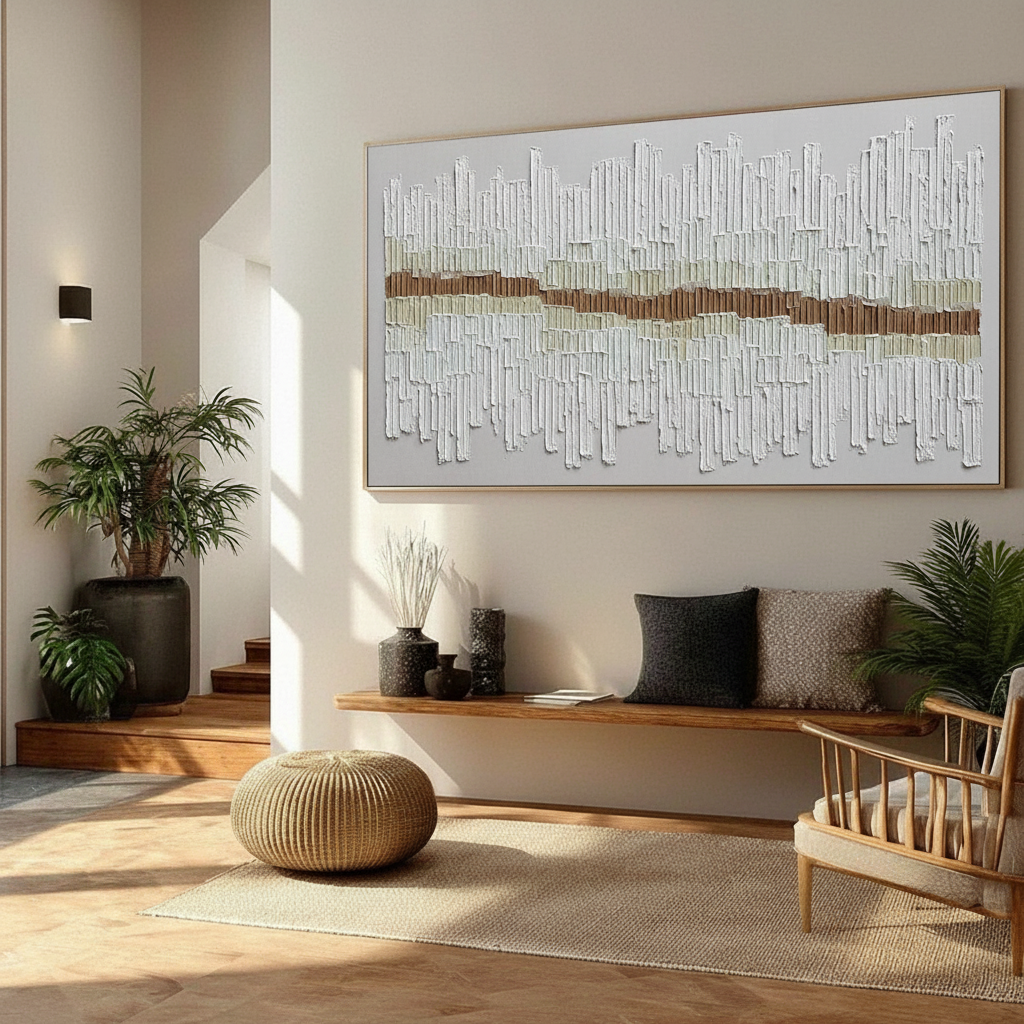
The New Luxury: Why Texture is the Soul of the 2026 Neutral Living Room
The aesthetic landscape of high-end residential design is undergoing a structural shift. For years, the "quiet luxury" trend favored flat, minimalist surfaces and digital prints. However, as we move toward 2026, a retreat from mass-produced perfection is evident. According to Marketplace.org, sales of high-end auction art plummeted 44% in 2024, signaling a move away from speculative "vanity" pieces toward artworks with real, tactile application value.
In a world saturated by digital imagery, the human brain craves the "essential identity" of physical objects. Research from the University of Chicago suggests that digital replicas and NFTs lack the artist's "soul" in the eyes of consumers, leading to a collapse in perceived value. This is further corroborated by a Columbia University study, which found that consumers value art labeled "AI-generated" 62% lower than authentic human-created pieces. For the home improver, this means a bold, hand-painted acrylic impasto isn't just a decoration; it is a high-value asset that anchors a room’s emotional resonance.

The Science of Sight: Why Impasto Textures Command Attention
Why does a heavily textured painting feel more "expensive" and engaging than a flat print? The answer lies in neuroaesthetics and optical physics. Passive art viewing consistently activates the medial prefrontal cortex (mPFC) and the amygdala, which are core circuits for emotional regulation. A systematic review of 85 records published in PMC confirms that these neurological mechanisms are optimized when the viewer interacts with complex visual stimuli.
Thick acrylic impasto creates a three-dimensional landscape on the canvas. From an optical standpoint, the quality of a painting is determined by how it scatters light. According to classical optical theory, when pigment particle diameters approach half the wavelength of visible light, scattering is maximized, creating the "glow" and opacity associated with high-quality paints. In impasto, these physical peaks and valleys create a dynamic interplay of light and shadow that changes as the sun moves through your living room.
Logic Summary: Our analysis of visual impact assumes that human-centric "imperfections" in texture act as a cognitive signal of authenticity, which the brain prioritizes over the flat consistency of digital prints.
Achieving Visual Harmony: The "Texture Zoning" Framework
The primary challenge in a neutral living room—often characterized by beige, ivory, or soft gray palettes—is preventing a bold texture from creating "visual noise." Professional interior designers use a technique called Texture Zoning to maintain balance.
1. The Focal Zone
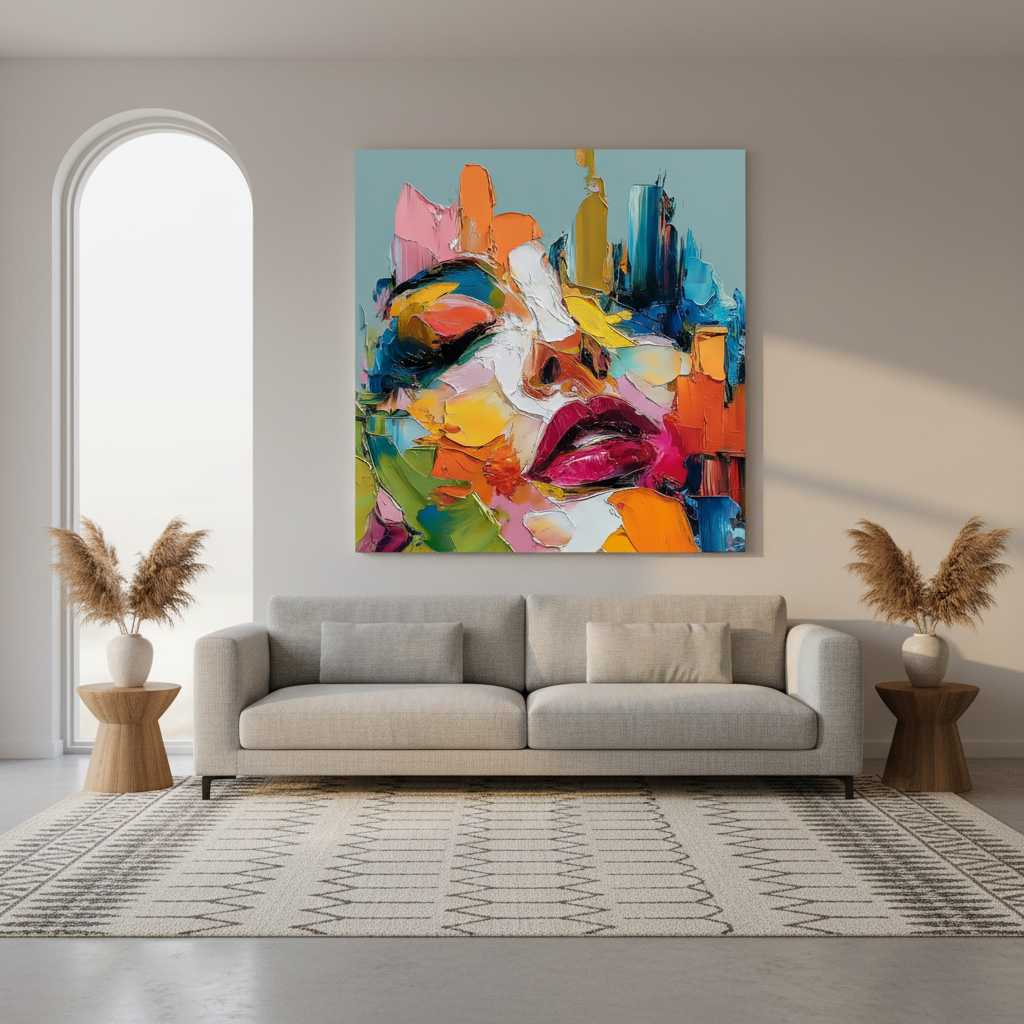
This is typically the wall above a sofa or a low mantel. In this zone, heavy impasto serves as the "anchor." Because neutral rooms lack high color contrast, the texture provides the necessary "visual weight" to prevent the room from feeling washed out.
2. The Transitional Zone
These are the areas between the art and the furniture. A common mistake is placing a heavy impasto piece too close to minimalist, sharp-edged furniture. This creates a "clash of languages." We recommend a minimum clearance of 8–12 inches between the bottom of the frame and the top of a sofa to let the "visual energy" of the texture dissipate.
3. The Background Zone
To avoid overwhelming the space, keep the surrounding walls "quiet." If you have a large textured piece, avoid placing it opposite reflective surfaces like large mirrors or glass partitions. As noted by experienced curators, reflective surfaces create distracting shadow patterns that can disrupt the intended dimensionality of the brushwork.

Technical Mastery: Lighting and Mounting Heavy Acrylics
A bold texture is only as good as its lighting. Standard flat lighting "kills" the shadows that give impasto its life.
The 2:3 Lighting Ratio
Seasoned curators often employ a lighting ratio principle: textured surfaces require 2 to 3 times more indirect illumination than flat artwork. Use adjustable wall-washers or ceiling-mounted track lights set at a 30-degree angle. This angle is steep enough to cast shadows into the paint troughs without creating a "glare" on the peaks.
Structural Integrity: The French Cleat Requirement
While a standard wire-and-hook system works for thin canvases, heavy impasto presents a different challenge. Specialized acrylics can be 10x thicker than standard heavy-body paints, adding significant weight. Some impasto textures can weigh between 5 to 10 pounds per square foot.
Modeling Note (Structural Assumptions):
Parameter Value or Range Unit Rationale Texture Depth 2.0 - 5.0 cm Standard heavy impasto range Paint Density ~1.1 - 1.3 g/cm³ Typical acrylic polymer density Estimated Weight 4.5 - 9.2 kg/m² Calculated based on volume Mounting System French Cleat N/A Required for shear force distribution Wall Anchor Toggle Bolt N/A Necessary for drywall without studs
For any piece where the texture exceeds 2cm in depth, we recommend a reinforced French cleat system. This distributes the weight across a horizontal bar, preventing the canvas from sagging or pulling away from the wall over time.
Material Integrity: Safety and Longevity
When selecting art for a residential space, the "invisible" components are as important as the visual ones.
The VOC and Heavy Metal Factor
Indoor air quality is a major concern for modern homeowners. The EPA warns that indoor air pollution can be significantly higher than outdoor levels. While acrylics are generally lower in VOCs than oils, the pigments themselves can carry risks. For instance, Cadmium compounds are classified as Group 1 carcinogens by the IARC.
At our studio, we prioritize the use of high-solids, low-VOC acrylics. It is a common misconception that an "ASTM D-4236" label means a product is non-toxic. According to the EPA, this label only indicates that the chronic health hazard warnings are compliant with regulations—not that the material is inherently safe for all environments. For homes with children or pets, we recommend water-based acrylics that have passed the BS EN 71-3 safety standard for heavy metal migration.
Solving the "SID" Mystery
Have you ever noticed a high-end white canvas turning a faint yellow or brown over time? This is often Support Induced Discoloration (SID). According to technical bulletins from Golden Artist Colors, water-soluble impurities in cotton or linen canvases are drawn out when thick acrylic mediums are applied. To prevent this, professional artists must apply multiple layers of a specialized "GAC 100" or equivalent sealer before the texture is added.

Maintenance: Preserving the Peaks
The very thing that makes impasto beautiful—its surface area—also makes it a "dust magnet." Research suggests that thick textures with added thickening agents (like sand or pumice) attract 3x more dust than smooth surfaces.
Cleaning Protocol:
- Never use liquid cleaners: Solvents can penetrate the porous structure of the impasto and cause the binder to swell or soften.
- Dry Brushing: Use a specialized, soft-bristled "hake" brush or a makeup brush to gently whisk away dust from the crevices.
- Humidity Control: Acrylic polymers are long-chain molecules that remain "soft" for months. High humidity can cause the paint film to swell by up to 7% in mass, as shown in ResearchGate studies, making it more susceptible to dirt adhesion.
The Economic and Emotional ROI of Original Texture
Investing in a hand-painted mural or a large-scale impasto piece isn't just an aesthetic choice; it's a strategic one. Data from the Royal Society shows a direct correlation between "art-dense" environments and relative gains in property value rankings. Furthermore, Americans for the Arts reports that government and private investments in the arts can yield a staggering 7:1 ROI in community and property revitalization.
Beyond the numbers, the psychological impact is profound. Nature-themed murals have been shown to reduce patient stress by 61% in clinical settings. In a home environment, a biophilic, textured painting acts as a "visual anchor" that lowers cognitive fatigue and burnout, especially for those working in high-density urban office spaces.
By balancing the bold physical presence of acrylic textures with the understated elegance of a neutral room, you create a space that is not only "camera-ready" but also fundamentally restorative.
YMYL Disclaimer: This article is for informational purposes only and does not constitute professional health, safety, or structural engineering advice. Always consult with a qualified professional before installing heavy artworks or using chemical-based art materials, especially in homes with sensitive individuals.
Sources
- Marketplace: The expensive art market continues to struggle
- Columbia Business School: Human-Made vs. AI Art Study
- UChicago: Does Artwork Preserve Essential Identity?
- PMC: Neurological mechanisms of creative arts
- EPA: Indoor Air Quality and Low-VOC Paints
- Golden Artist Colors: Support Induced Discoloration
- Royal Society: Quantifying the link between art and property prices
- WHO: Scoping Review on Arts and Health

Leave a comment
This site is protected by hCaptcha and the hCaptcha Privacy Policy and Terms of Service apply.