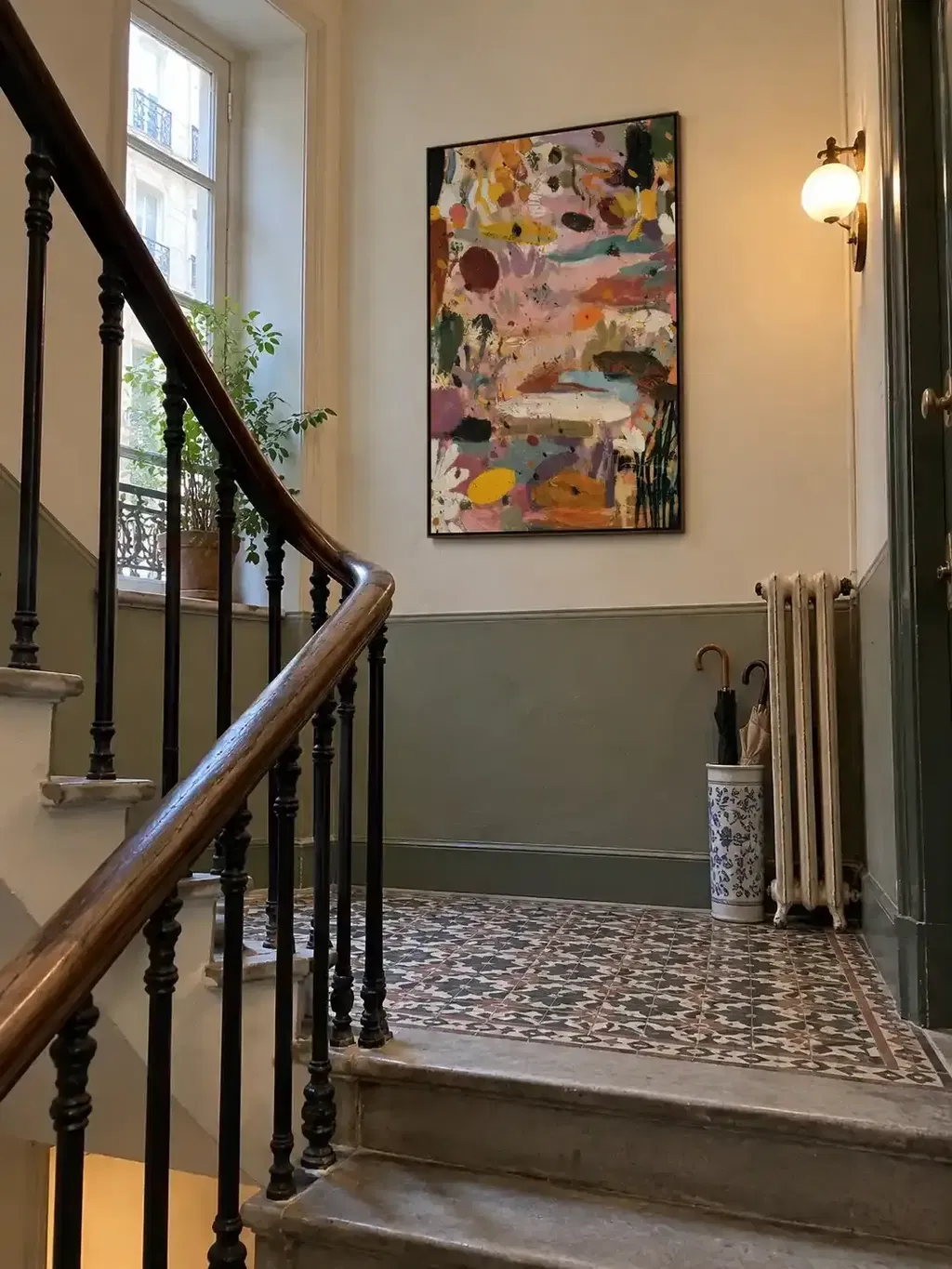
A painting that looks right in a friend's living room can look stranded on your own wall, and the reason is often the ceiling. Wall art and ceiling height affect each other in ways most people overlook: the taller the wall, the bigger and often more vertical your art needs to be.
Get the match right and the piece feels anchored instead of adrift. Here's how to size art for every ceiling height.
Quick Chart: Art Size and Direction by Ceiling Height
Find your ceiling height and read across for orientation and center height. Width always traces back to your sofa, so it stays constant across every row.
| Ceiling | Orientation | Center height |
|---|---|---|
| Under 8ft | Horizontal | 54"-57" |
| 8ft | Horizontal / standard | 57" |
| 9ft | Either, lean vertical | 60" |
| 10-12ft | Vertical / stacked | Raised, 60"-66" |
| Vaulted / stairs | Follow the slope or steps | Varies |
The pattern is simple: the higher the ceiling, the taller and more vertical the art, and the higher its center sits. Width never changes.
Why Ceiling Height Changes What Size Art You Need
Most sizing advice only looks at the furniture below the art, not the wall behind it. That works until the ceiling gets tall, and then a correctly sized painting can still look small and lonely with a stretch of bare wall above it.
Height changes two things: how tall your art should be and where its center should sit. A taller wall has more vertical space to fill, so a short piece reads as undersized even when its width is spot on.
One thing stays fixed, though. The width of your art still comes from the furniture below it, usually two-thirds to three-quarters of your sofa, the same 2/3 rule that governs any sofa wall.
Ceiling height doesn't touch that part. It only changes the vertical side of the equation.

What Size Art for an 8-Foot Ceiling?
An 8-foot ceiling is the standard baseline, so the usual rules apply with no adjustment. Hang the center of your art at 57 inches from the floor, the standard eye level for most adults in the US.
Horizontal art suits this height best. Keep the piece from creeping too close to the ceiling, leaving at least 8-12 inches of breathing room above the top edge.
For a standard 84-inch sofa, that points to art around 50-63 inches wide / 127-160cm and a moderate height of roughly 40-48 inches. A single horizontal canvas or a compact set of two works cleanly here.

What Size Art for a Ceiling Under 8 Feet?
Low ceilings (7 to 7.5 feet, common in older homes, apartments, and basements) call for the opposite instinct. Stay horizontal and restrained, and skip tall vertical pieces that shrink the room.
Lower the center slightly, to about 54-57 inches, and keep the top of the art well clear of the ceiling. A horizontal layout actually helps here, pulling the eye sideways and making the wall feel wider.
- Orientation: horizontal, always.
- Size: moderate, not oversized. A wide-but-short canvas beats a tall one.
- Tip: lighter colors and slim frames keep a low room feeling open.
What Size Art for a 9-Foot Ceiling?
A 9-foot ceiling, the most common in newer homes, gives you the most balanced canvas to work with. Nudge the center up to about 60 inches to suit the extra height.
Vertical art starts to earn its place here. You can still go horizontal, but two pieces stacked one above the other fill the wall nicely while keeping the width tied to your sofa.
For an 84-inch sofa, look for art around 54-65 inches wide / 137-165cm, taller than you'd use on an 8-foot wall.
What Size Art for a 10-Foot Ceiling or Higher?
At 10 feet, small art gets lost fast. Size up by roughly 10-20 percent, especially in height, and reach for vertical or stacked arrangements.
Raise the center to around 60-65 inches, but keep the bottom edge a normal 6-10 inches above the sofa back so the piece still feels connected to the furniture. Tall walls tempt people to float the art upward, which breaks that connection.
Good options here: a large vertical canvas, a vertical triptych, or two large pieces stacked. For an 84-inch sofa, that's roughly 60-72 inches wide / 152-183cm with noticeably more height.
What Size Art for an 11 or 12-Foot Ceiling?
Lofts and double-height rooms let you go bold. Increase the size by 20-50 percent over standard, and treat the wall as a vertical canvas rather than a single spot above the sofa.
From there, you have two directions. One oversized vertical painting can carry the whole wall for a single dramatic focal point, or a stacked, multi-row arrangement can climb toward the ceiling for a layered, collected feel.
| Approach | Best for |
|---|---|
| One extra-large vertical painting | A clean, bold focal point on a tall wall |
| Stacked or multi-row arrangement | Filling height while keeping a relaxed, layered look |
For an 84-inch sofa under a very tall ceiling, art widths of 65-80+ inches / 165-203cm and heights of 60-80 inches keep the scale right. Center height runs 60-66 inches, sometimes higher to use the space.
How to Hang Art on a Vaulted or Sloped Ceiling
A vaulted ceiling has no single height to measure against, so the usual centerline rule doesn't apply. Use the middle portion of the wall as your reference instead.
Hang the art on the lower, more vertical part of the wall, where a person would naturally rest their eyes, rather than chasing the peak of the slope. Keep the bottom edge anchored to whatever furniture sits below.
The taller side of a sloped wall can take a larger or vertical piece, while the shorter side suits something more compact. Balancing the two keeps the wall from feeling lopsided.
How to Hang Art on a Two-Story or Staircase Wall
Tall staircase walls follow the stairs, not a flat eye level. Step the art downward along the same diagonal as the steps, so each piece sits at a comfortable height for that point on the staircase.
A series of pieces works better here than a single one. Space them evenly and let the arrangement descend with the stairs, keeping each piece a similar distance from the steps beside it.
A vertical gallery wall also shines in this spot, climbing the tall wall while echoing the line of the staircase.

Why You Get Empty Wall Above the Painting (and How to Fix It)
The most common mistake on a tall wall is art that's the perfect width but too short, leaving a wide band of empty wall above it. The width matches the sofa, so it looks half-right, yet the vertical gap gives it away.
The fix is rarely about width. Reach for any of these instead:
- Go taller. Choose a piece with more height, or a vertical orientation.
- Stack pieces. Two canvases hung one above the other fill the vertical space.
- Raise the center. On a tall wall, lifting the center to 60-66 inches closes the gap up top.
Adding width to a too-short piece won't help. Height is what fills a tall wall.

Montcarta Scales Art to Tall Walls
Once the size and orientation suit your ceiling, the painting still has to suit the room's colors, where the 60-30-10 rule comes in and your art usually fills the accent share. Size and color together make a piece look made for the space.
For tall walls, Montcarta hand-paints large-format and vertical originals in oil and acrylic on canvas, sized to your exact wall or as a set. Measure your ceiling, then find art scaled to match it.
FAQs
Q1: How high should I hang art with 10-foot ceilings?
Raise the center to about 60-65 inches from the floor, up from the standard 57. Keep the bottom edge 6-10 inches above the sofa, and lean toward taller or vertical art to fill the wall.
Q2: What size art works with low ceilings?
Stay horizontal and moderately sized. A wide, shorter canvas makes a low room feel wider, while a tall piece emphasizes the lack of height. Lower the center slightly to 54-57 inches and leave clear space between the top of the art and the ceiling.
Q3: Should I use vertical or horizontal art for high ceilings?
Lean vertical. On ceilings of 9 feet and up, vertical art or stacked pieces fill the tall wall better than a single horizontal canvas, though horizontal art still works above a wide sofa.
Q4: Where do I hang art on a vaulted or staircase wall?
On a vaulted wall, use the middle portion of the wall and hang the art on the lower, vertical section near eye level. On a staircase wall, step the pieces downward along the angle of the stairs, keeping each one a comfortable height for that part of the staircase.