

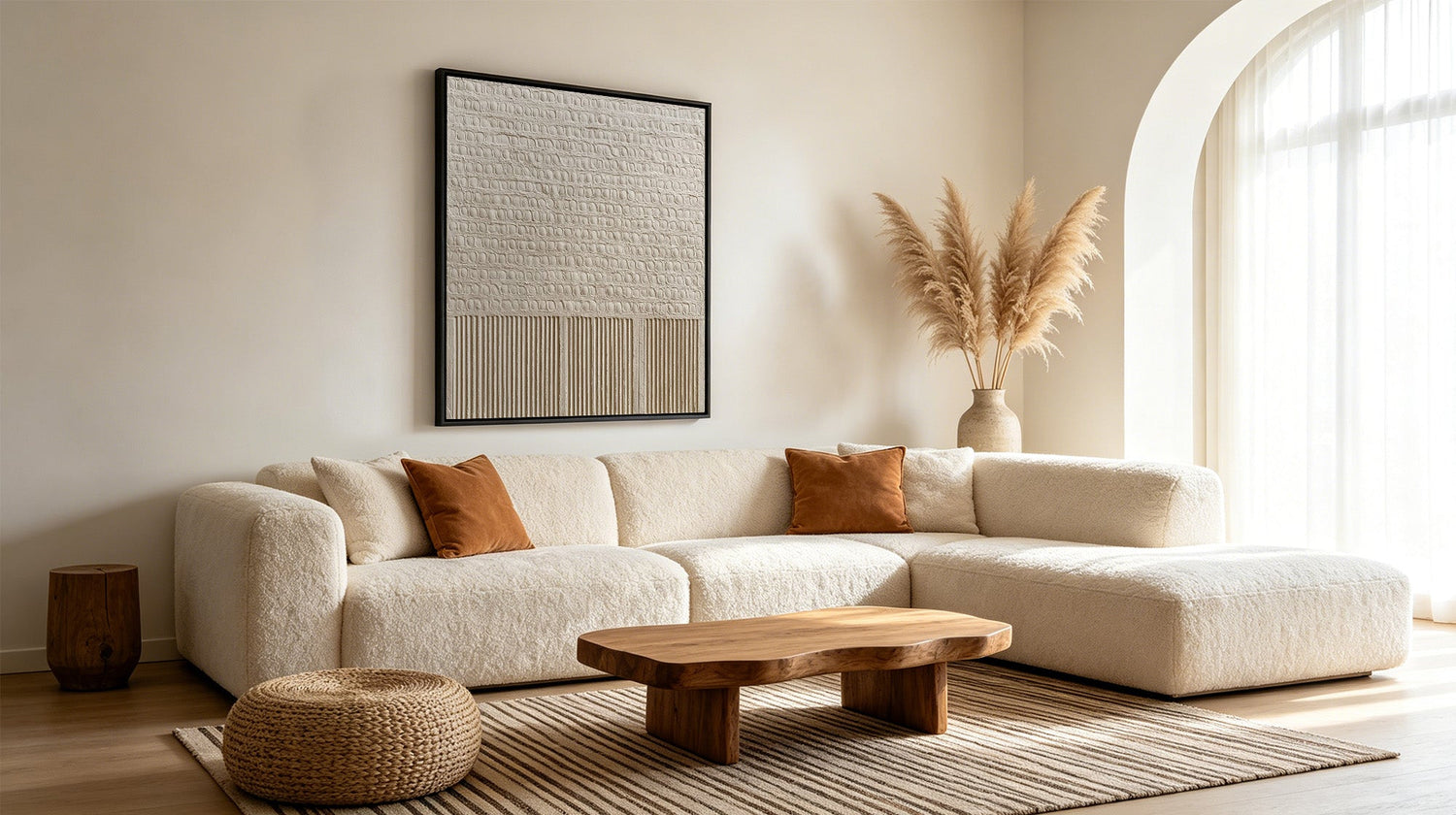
You scroll past a photo of a quiet room. Bare walls, a single painting in earthy tones. Nothing loud, nothing demanding. Yet something about it makes you stop. That feeling has a name: wabi sabi. You've likely seen the term on design feeds and gallery pages, but what it describes runs deeper than an aesthetic. It started in 15th-century Japan and has shaped the way people see beauty ever since.
What "Wabi" and "Sabi" Actually Mean
Wabi: The Beauty of the Unfinished
In 16th-century Japan, wabi described a quality found in objects that were plain, irregular, or unfinished. The word comes from tea ceremony culture, where tea masters deliberately chose rough-edged bowls and simple wooden utensils over fine porcelain. These objects felt honest and grounded. Their imperfections were not flaws to apologize for. They were the point.
Sabi: What Time Leaves Behind
Sabi refers to what time does to things. The worn surface of an old chair. The color shift in a painting that has aged in sunlight. Rust, patina, slow fading. These are signs of use and passage, not damage. Sabi asks you to see that evidence of time as something worth noticing rather than something to fix.
How the Two Work Together
Combined, wabi sabi describes a way of seeing that accepts impermanence and incompleteness as natural states. This philosophy traces back to Zen Buddhist thought and was shaped substantially by tea master Sen no Rikyu in the 15th and 16th centuries. From tea rooms and garden design, it extended into painting, pottery, architecture, and the way entire interiors are put together.

What Wabi Sabi Art Looks Like
Texture Over Smoothness
Wabi sabi art paintings are rarely smooth. The surface carries visible marks: thick brushstrokes, layered paint, cracked or gritty texture. These are not accidents. They are information. A surface that shows how it was made tells a different story than one that hides its process. In wabi sabi art, the making is part of the meaning.
A Palette Borrowed from Nature
The colors in wabi sabi painting are the ones you find outside when nothing dramatic is happening. Limestone white. Clay beige. Charcoal gray. Moss green. Weathered rust. These are not colors that pull attention toward themselves. They let your eyes settle. High-saturation tones belong to a different conversation entirely.
Subject Matter as Philosophy
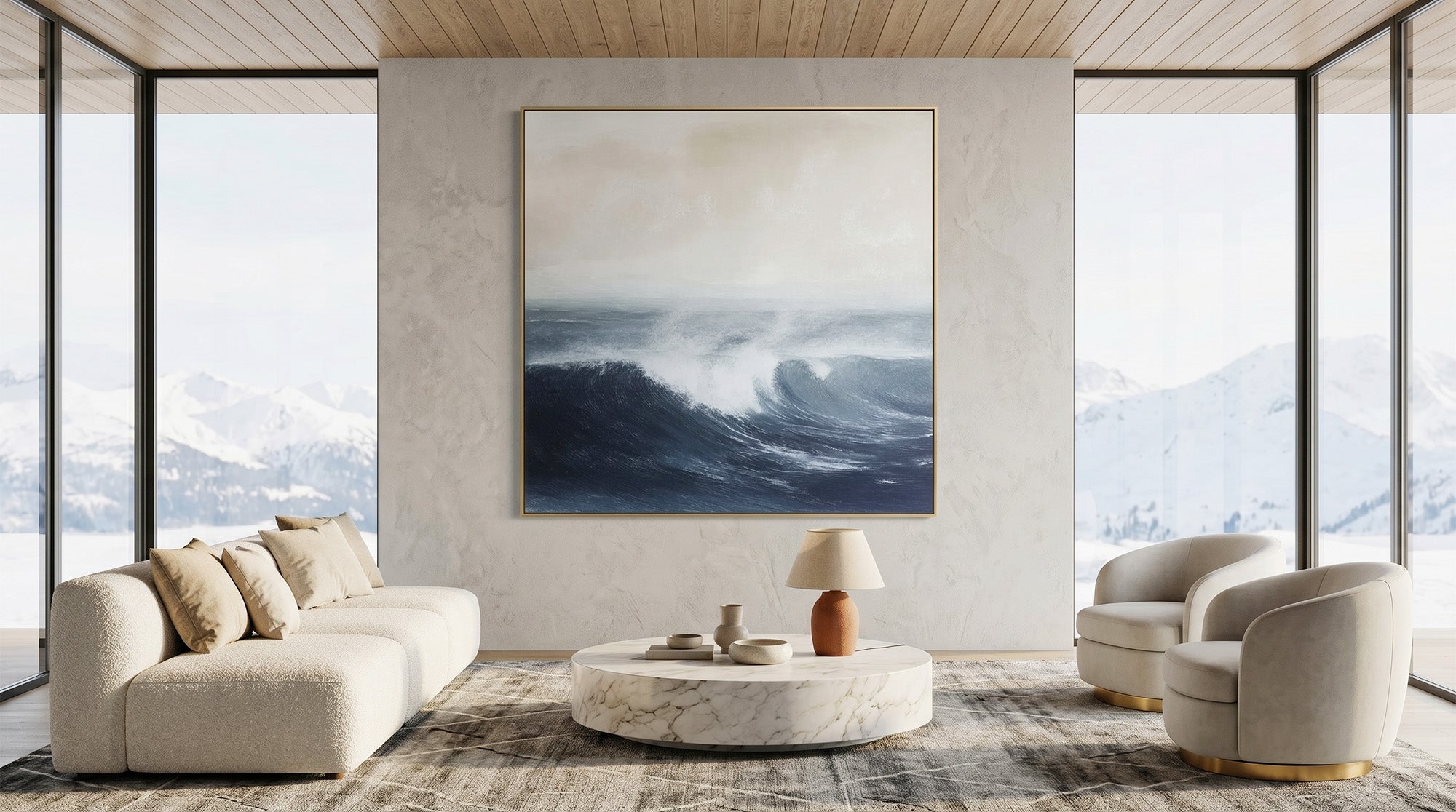
Wabi sabi art does not look for grand subjects. A bare branch. A shoreline after the tide pulls back. A single weathered stone. These subjects carry the same qualities the philosophy values: simplicity, quiet, transience. They show something in its reduced form, and they remind you that this state is temporary too.
How Wabi Sabi Art Differs from Minimalism
People often group wabi sabi with minimalism because both use restraint. But they start from opposite places.
Minimalism is about subtraction. You remove everything unnecessary until the space or image is clean, precise, and controlled. The goal is perfection through elimination. A minimalist painting might place one line on a white canvas, and that line will be exactly where it should be.
Wabi sabi does not aim for perfection. It keeps imperfections deliberately. The goal is not control. It is acceptance. A wabi sabi painting may have an uneven edge, a smear of earth-toned pigment, a composition that does not quite balance. Those qualities carry the meaning.
| Minimalism | Wabi Sabi | |
|---|---|---|
| Goal | Perfection through removal | Acceptance of imperfection |
| Surface | Clean, flawless | Textured, marked |
| Composition | Precise, deliberate | Asymmetric, organic |
| Question it asks | What can be taken away? | What story does this mark tell? |
One approach works toward a controlled ideal. The other finds value in what is already present, marks, time, and all.

How to Use Wabi Sabi Art in Your Home
Which Rooms Benefit Most
Bedrooms respond well to wabi sabi art because the aesthetic supports rest rather than stimulation. A painting with earthy tones and soft texture sits quietly in the background when you want it to, and rewards attention when you slow down.
A home office or reading corner is another strong fit. Wabi sabi art stays out of the way visually, which helps in spaces where focus matters. A dining room works too, particularly when you want art that opens conversation without dominating the table setting.
Where it tends to work less well: children's rooms that need visual energy, and spaces built around bold, high-contrast styles that would work against the quieter register of wabi sabi.
What to Put Around It
The materials nearest to a wabi sabi painting should share its honesty: linen, raw wood, ceramic, and rattan. These textures carry the same unprocessed quality. High-gloss metal finishes, patterned wallpaper, and saturated-color furniture compete with the painting's frequency rather than supporting it. Give the piece room to communicate without surrounding noise.
Why a Hand-Painted Original Changes the Experience
One of the core ideas behind wabi sabi is that the maker's hand matters. During Sen no Rikyu's time, a hand-pinched tea bowl was valued above a factory piece precisely because you could see the fingerprints in the clay. That irregularity proved a human presence, and the presence was considered part of the object's worth.
A print can replicate the composition and color of a wabi sabi painting. What it cannot replicate is the physical surface. The raised texture of impasto paint, the variation in how pigment sits on canvas from section to section, the slight inconsistency in a brushstroke: these are absent in reproduction. In wabi sabi art, the surface is not decoration. It carries the meaning.
Every hand-painted original also holds its own particular imperfections. A small ridge here, a deepened shadow there. No two are identical. That uniqueness connects directly to the sabi aspect of the philosophy: this piece was made at a specific moment by a specific hand, and that moment is now part of its history.

Bring This Philosophy to Your Walls
A wabi sabi painting does not try to impress you. It sits on the wall and rewards quiet attention: a texture you notice on a slow morning, a color that shifts with the light, a composition that does not resolve neatly and is not trying to. If you want to bring that quality into your home, Montcarta's Wabi Sabi collection offers hand-painted originals with the impasto texture and earthy tones this aesthetic calls for. See the full collection at montcarta.com.
Frequently Asked Questions
Q1: Is Wabi Sabi Art the Same as Traditional Japanese Art?
No. Traditional Japanese art covers many distinct styles and forms, including woodblock prints and ink painting. Wabi sabi is a philosophy, not a visual style. A contemporary abstract painting with earthy tones and visible texture carries wabi sabi qualities without being traditionally Japanese in form. The two can overlap, but they are not the same.
Q2: Can Wabi Sabi Art Work in a Modern or Contemporary Interior?
Yes. Wabi sabi and contemporary interiors share restraint. The key is giving the piece enough breathing room. A wabi sabi painting on a plain wall with simple furniture and a few natural materials nearby fits comfortably in a modern room. The fewer objects competing for attention nearby, the stronger the painting reads.
Q3: Does Wabi Sabi Art Have to Be Abstract?
No. Wabi sabi art includes representational subjects: bare branches, weathered coastlines, single stones. The distinction is not abstract versus figurative. It is whether the work communicates simplicity, impermanence, and a hand-made quality. A realistic painting of a worn wooden dock carries a wabi sabi feeling. A complex, high-detail abstract in saturated colors does not.
Q4: What Colors Pair Well with Wabi Sabi Wall Art?
Off-white, warm gray, and raw wood tones work best as surrounding colors. Matte wall finishes complement the textured surfaces in wabi sabi paintings more naturally than high-gloss paint. Heavily saturated wall colors compete with the palette of the work and undercut the calm the painting creates. Neutral and low-key backgrounds let the piece hold the room.
Q5: What Size Wabi Sabi Painting Works Best for a Living Room?
Larger pieces, typically 24 inches wide or more, tend to work better than smaller ones. Wabi sabi aesthetics rely partly on negative space and room to breathe. A small painting on a large wall can feel tight, which works against the philosophy. Give the piece enough space to exist without crowding it with neighboring objects or additional art.


Leave a comment
This site is protected by hCaptcha and the hCaptcha Privacy Policy and Terms of Service apply.