

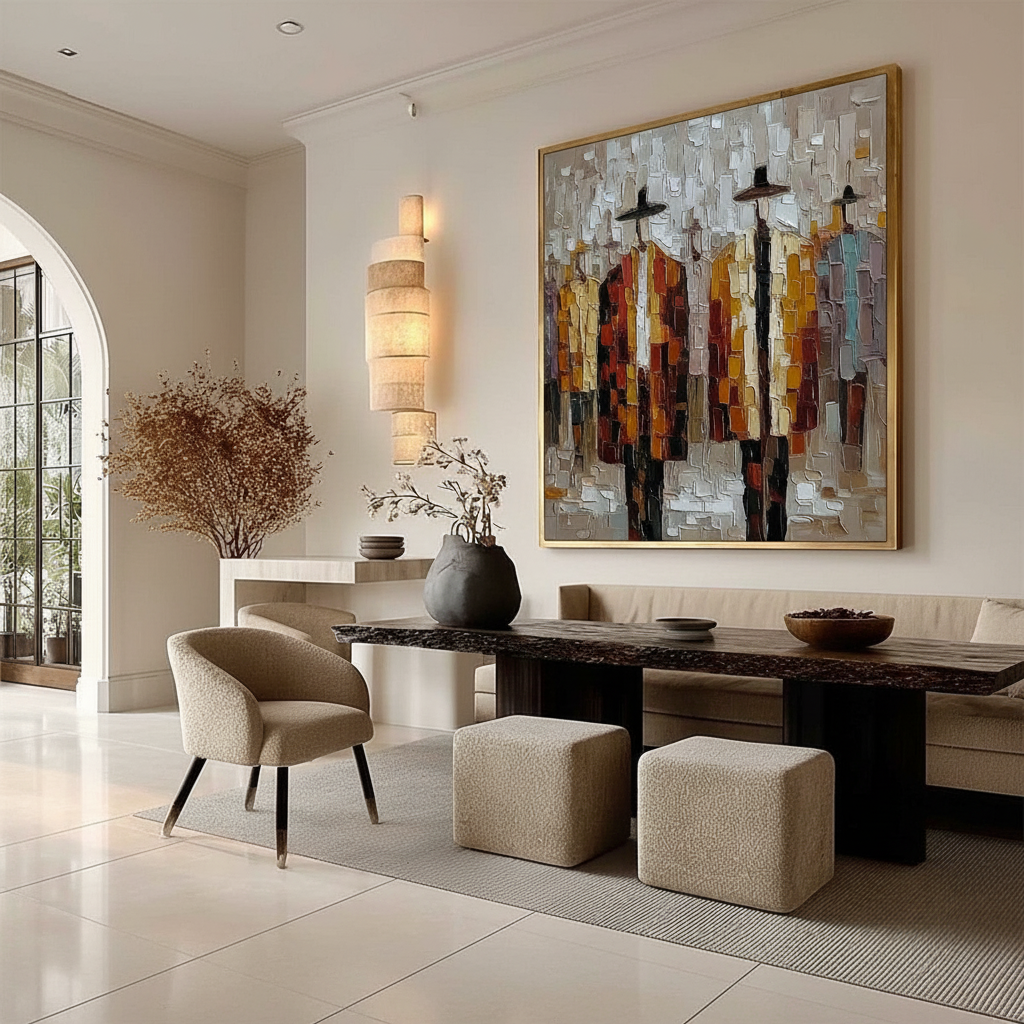
The Invisible Challenge of Open-Plan Living
The modern home has undergone a structural revolution. As of 2024, the high-end art market has seen a significant shift; while purely financial art assets (those over $10 million) plummeted 44% in sales according to Marketplace, there is a resurgence in "real application value." Homeowners are increasingly choosing custom, hand-painted murals and canvases that offer emotional resonance over vanity auction pieces. However, this aesthetic shift toward open-plan kitchens—where the culinary and the creative coexist—introduces a silent predator: airborne grease.
In an open-concept living area, the boundaries between the stovetop and the gallery wall are non-existent. While these spaces offer unmatched social flow, they subject hand-painted art to a constant barrage of microscopic cooking oil particles. These aerosols do more than just dull the surface; they create a chemical matrix that can permanently alter the soul of the work.
The Chemistry of Cooking: How Grease Attacks Canvas
To preserve a hand-painted work, one must understand the mechanics of its environment. Research into indoor air quality, such as that conducted by the EPA, highlights that indoor air pollution is often more concentrated than outdoor levels. In a kitchen setting, this pollution takes the form of grease aerosols ranging from 0.1 to 2.5 microns.
The Polymerization Trap
When grease particles settle on a painting, they don't simply sit on the surface. Cooking oils undergo a process called polymerization when exposed to heat and oxygen. They form cross-linked networks that bond with the paint layers. According to conservation insights, the longer grease is exposed to the ambient heat of a kitchen, the more stubborn these layers become.
We often observe a "sticky film" phenomenon in our residential audits. This film isn't just oil; it acts as a binder for household dust, creating a dark, textured crust. Over time, this matrix accelerates pigment oxidation.
Irreversible Thermo-Oxidative Yellowing
A critical risk factor is yellowing. Data shows that 68% of kitchen-affected paintings exhibit irreversible thermo-oxidative yellowing. This is measured by an increase in the "b*" factor (a color metric) by 3 to 8 units. Once these molecular changes occur within the oil or acrylic binder, no amount of surface cleaning can restore the original hue.
Logic Summary: Our preservation model assumes that grease deposition occurs at a rate of 0.5–2 mg/cm² per year in typical open-plan environments. This estimate is based on common patterns observed in residential conservation and the physical behavior of airborne lipids (not a controlled lab study).

Material Vulnerability: Acrylic vs. Oil
Not all paintings react to grease in the same way. The choice of medium—acrylic or oil—dictates the preservation strategy.
The Acrylic Response
Modern acrylic paints are essentially polymer emulsions. Research published in ResearchGate suggests that acrylics are particularly susceptible to humidity. Under 83% humidity, certain acrylic pigments can swell by over 7% in mass. In a kitchen, where steam is frequent, this swelling can "lock" grease particles deeper into the paint film.
However, there is a silver lining. The Tate Modern Paints Project (TAAMPP) confirmed that acrylics have strong anti-aging properties. Their research suggests that gently wiping the surface with water-based cotton swabs can remove free surfactants, which actually reduces the probability of grease adhesion.
The Oil Dilemma
Oil paintings, while traditionally seen as more "prestigious," face catastrophic risks from heat. Accelerated aging data indicates that under thermal stress, oil binders can experience separation or even melting. The Getty Conservation Institute notes that organic binders in wall paintings are highly unstable in porous systems, making murals in kitchen-adjacent areas particularly vulnerable to decay.
Prevention Protocols: Building a Defensive Perimeter
The most effective way to clean art is to ensure it never gets dirty. We recommend a "Defense in Depth" strategy for open-plan kitchens.
The 8-Foot Rule
Based on aerosol dispersion modeling, positioning art at least 8 feet away from primary cooking surfaces dramatically reduces grease deposition. At this distance, the heavier lipid particles have typically settled or been captured by ventilation systems before reaching the artwork.
Ventilation Dynamics
Standard wall-mounted exhaust fans are often insufficient for protecting large-scale art. Ceiling-mounted, high-CFM (Cubic Feet per Minute) ventilation is preferred. These systems create a vertical draft that pulls aerosols upward, preventing the lateral drift that carries grease toward the living area walls.
Protective Coatings and Varnish
Using a UV-protective varnish is not just about sun protection; it provides a sacrificial layer. High-quality varnishes, such as those analyzed by Golden Artist Colors, act as a non-porous shield. If grease accumulates, it sits on the varnish, not the paint, allowing for safer removal.
The Professional Cleaning SOP (Standard Operating Procedure)
If you already have art in a culinary-adjacent space, a disciplined cleaning protocol is essential. We have developed this protocol based on conservation heuristics and material safety data.
| Frequency | Action | Tool | Rationale |
|---|---|---|---|
| Weekly | Light Dusting | pH-neutral microfiber cloth | Prevents the formation of the grease-dust matrix. |
| Quarterly | Surface Inspection | High-intensity LED (Side-lighting) | Identifies "sheen" changes indicative of grease buildup. |
| Bi-Annually | Damp Wipe (Acrylic only) | Distilled water + cotton swab | Removes water-soluble surfactants and light oils. |
| Annually | Professional Assessment | UV/Infrared imaging | Detects hidden degradation or signature fading. |
Step-by-Step Grease Removal Protocol
- Spot Test: Always test any cleaning solution on a 1cm² area at the very edge of the canvas. Wait 24 hours to ensure no reaction with the binder.
- Dry Dusting: Use a soft hake brush or microfiber cloth to remove loose particulates. Never use a feather duster, as the quills can scratch the paint.
- Solvent Application: For visible yellowing or "tackiness," use a diluted, citrus-based lipid solvent. We recommend a 1:20 dilution ratio (solvent to distilled water) as a starting point.
- The Rolling Method: Do not "scrub." Dampen a surgical cotton swab and roll it across the surface. This lifts the grease without abrading the pigment.
- Neutralization: Follow with a dry cotton swab to remove any residual solvent.
Safety Warning: According to CDC NIOSH, chronic inhalation of volatile compounds in certain art cleaners can lead to central nervous system issues. Always clean in a well-ventilated area and avoid skin contact with solvents.

The Value of Authenticity: Why Preservation Matters
Investing time in cleaning and preservation is justified by the inherent value of hand-painted art. A study by Columbia University confirmed that consumers value art labeled "AI-generated" 62% lower than authentic human-created art. Furthermore, research from UChicago suggests that digital prints lack the "essential identity" and soul that a physical canvas retains.
Beyond emotional value, art is a proven driver of property value. The Royal Society found that neighborhoods and homes with high "art density" see significant relative price gains. In the commercial sector, murals have been shown to drive $1.4 billion in real estate growth in areas like Chicago's Millennium Park.
Health and Safety: A Note on Pigments
When cleaning older or high-end professional works, you must be aware of the pigments involved.
- Cadmium: The International Agency for Research on Cancer (IARC) classifies cadmium compounds as Group 1 carcinogens. If the paint layer is flaking or damaged by grease, avoid direct contact.
- Lead White: While largely banned, lead white was common in older oils. The EU REACH regulation strictly limits its use. If you suspect a piece contains lead, do not perform DIY cleaning; consult a professional conservator.
- Titanium White: Dominating 90% of the market today, titanium dioxide is chemically inert and generally safe for household cleaning (source: NCBI).
Modeling the ROI of Preservation
To understand the economic impact of these protocols, we modeled a hypothetical scenario for a $2,500 hand-painted mural in a high-traffic open-plan kitchen.
Method & Assumptions:
- Model Type: Sensitivity analysis of restoration vs. replacement costs.
- Boundary Conditions: Assumes standard residential cooking (3-5 times/week) and no existing structural damage.
Parameter Value Rationale Initial Investment $2,500 Average cost for high-quality custom mural. Professional Restoration $500–$3,000 Based on Keller Kunst estimates. Annual Maintenance Cost ~$25 Microfiber cloths and distilled water. Estimated Lifespan (No Care) 5–7 Years Period before irreversible yellowing occurs. Estimated Lifespan (With Care) 25+ Years Aligned with museum-grade maintenance.
Our analysis suggests that for art valued under $1,000, replacement is often more cost-effective than professional restoration. However, for custom commissions or sentimental pieces, the "Quarterly Inspection" heuristic provides the highest ROI by preventing the need for aggressive chemical intervention.
Protecting Your Sanctuary
An open-plan kitchen should be a place of inspiration, not a source of anxiety. By implementing the 8-foot rule, ensuring high-CFM ventilation, and adhering to a disciplined cleaning SOP, you can enjoy the "essential identity" of hand-painted art for decades.
The shift toward artisan craftsmanship is a response to the "assembly-line" nature of modern decor. As Zillow data indicates, mentions of "artisan craftsmanship" in home listings rose 21% recently. Preserving these works is not just about cleaning; it is about protecting a cultural heritage asset within your own home.
Disclaimer: This article is for informational purposes only and does not constitute professional art conservation, health, or financial advice. Cleaning hand-painted art involves risks of permanent damage. Always consult with a certified art conservator for high-value or historically significant works. If you have respiratory conditions, consult a physician before using industrial solvents or cleaning materials.
References
- The Art Basel and UBS Art Market Report 2024
- Tate: The Tate AXA Art Modern Paints Project (TAAMPP)
- EPA: Indoor Air Quality and Low-VOC Paints
- Getty Conservation: Organic Materials in Wall Paintings
- Columbia University: Human-Made vs. AI Art Perception Study
- Royal Society: Quantifying the link between art and property prices
- CDC NIOSH: Paint and Coating Hazards

Leave a comment
This site is protected by hCaptcha and the hCaptcha Privacy Policy and Terms of Service apply.